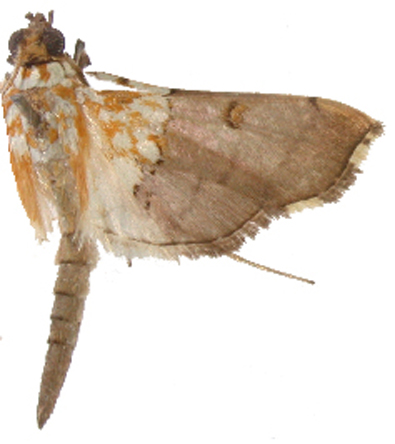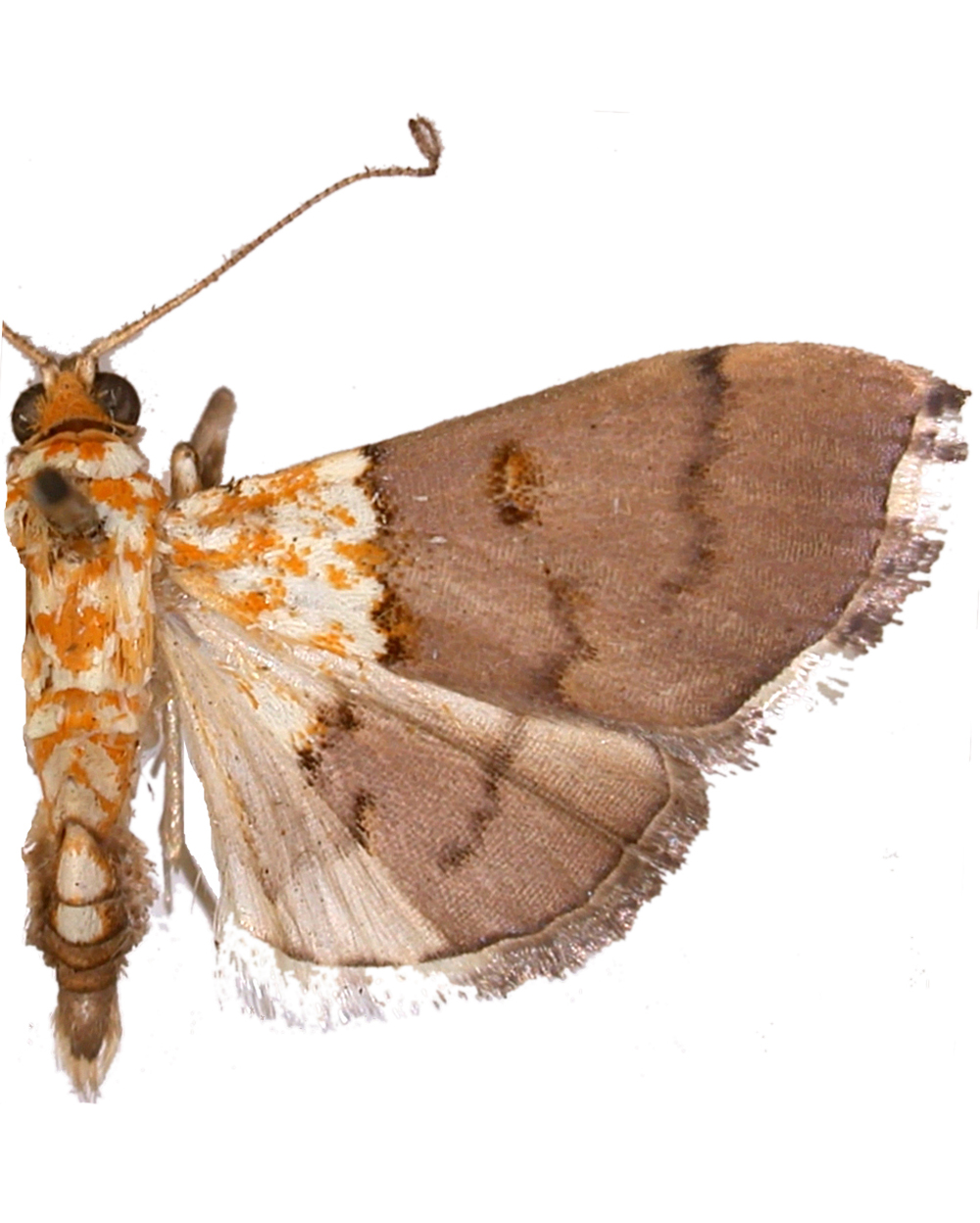
Agrotera basinotata Hampson
- Family: Crambidae
- Subfamily: Spilomelinae
- Tribe: Agroterini
- Genus: Agrotera
- Distribution: Sri Lanka, India (Kerala, Assam, Meghalaya), Burma, Thailand, W. Malaysia, Singapore, Sabah, Indonesia (Kalimantan Timur), PNG, Australia (Q), Hawaii [introd.]. Taiwan, China (Yunnan, Hong Kong), Japan.
- Habitat: Lowland to lower montane primary forest <1460m
- Wing Length: 10mm
Taxonomy
The male and female types of Agrotera basinotata Hampson, 1891: 137, pl. 155 fig 13. are from an unknown location. The basinotata name was first created by Warren (ms comb. n.). Hampson (1891: 137) in his description, notes that there are other specimens in the BM from NW India.
Description
The basal area of both wings are cream speckled with orange. Distally the wings are a deep purple with brown lineation. The FW margin and fringe is chequered with purple on white. The anal and tornal area of the HW is pale as in many Agrotera spp. Although distinctively patterned this taxon is part of a sp. complex which needs investigation. In this A. basinotata group there is much minor variation in size, colouration and patterning. In one morphotype the post median line angles basally at the costa, in another it is perpendicular. Male Agrotera species have elongate abdomens in comparison with the females and sexual dimorphism in patterning may be complicating the situation. It is difficult to separate it from A. posticalis and most other members of the group without reference to the genitalia. A poor specimen from Kalimantan Timur, (Pasir, Gunung Lumut Protection Forest) in the RMNH Leiden RMNH.INS.19448has been DNA barcoded (BOLD; Ratnasingham & Hebert 2007).
Life History
Introduced into Hawaii in an attempt to control Melastoma malabathricum.
Foodplants M. malabathricum (straits rhododendron or senduduk) (Melatomaceae), Syzygium buxifolium, Syzygium cumini, (Myrtaceae), Sudheendrakumar & Mathew (1999 Appendix 1: 55) give Lagerstroemia parvifolia (Lythraceae), Eugenia operculata (Myrtaceae), Pavetta indica (Rubiaceae) Beta vulgaris (beetroot) (Chenopodiaceae) and Brassica oleracea-cultivar group (cabbage) (Brassicaceae).
References
- Hampson,G.F. (1891) The Lepidoptera Heterocera of the Nilgiri district.. Ill. typ. spec. Lepid. Heteroc. coll. B.M., 8. 144 pp., pl. 139-156, London.
- [RTS] Robinson, G.S., Tuck, K.R. & Shaffer, M. (1994) A Field Guide to the Smaller Moths of South-East Asia, Malaysian Nature Society Kuala Lumpur & Natural History Museum, London, 311 pp. 51 text figs, 32 pls.
- Sudheendrakumar, V.V. & Mathew, G. (1999) Studies on the diversity of selected group [sic] of insects in the Parambikulam Wildlife Sanctuary, Kerala Forest Research Institute, Peechi, Thrissur, 77pp.
- Ratnasingham, S. & Hebert, P.D.N.(2007) Barcoding - BOLD: The Barcode of Life Data System (www.barcodinglife.org), Molecular Ecology Notes (Journal compilation © 2007 Blackwell Publishing Ltd.: 10 pp.