Taxonomy
The holotype of Crambus partellus Swinhoe, 1885: 879 is from India (Bombay).
Description
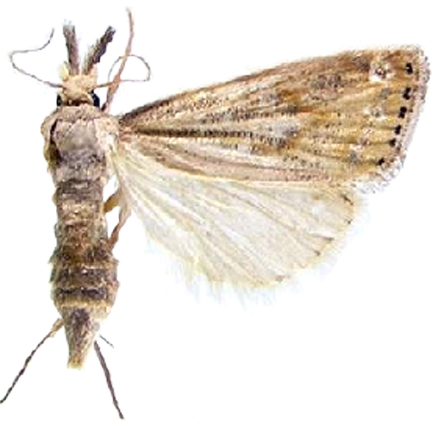
Relatively small moths, females generally much larger than males. The FW is ochreous with a darker speckling and has a pleated appearance. The HW is pearly white with a faint black marginal line. This is another common pest species, widely misidentified.
Life History
The spotted stemborer. In Nepal the egg, larval and pupal periods occur from April to September and lasted 4-5, 16-41 and 4-8 days, respectively. A complete generation took 28-48 days under summer conditions and 192-233 days from October to May (Neupane et al. 1985). C. partellus larvae feed in leaf funnels, causing characteristic scars and holes. They later feed at the growing point, which may be killed. The dead central leaves then form a characteristic 'dead-heart', especially in young plants. Older larvae tunnel extensively in stems and in maize cobs, weakening the stems, which may break and lodge; damage to inflorescences may interfere with grain formation, causing chaffy heads in sorghum. Similar symptoms are produced by other species of cereal stem borer.
References
- Bleszynski, S. & Collins, R.J. (1962). A short Catalogue of the World Species of the Family Crambidae (Lepidoptera). Acta Zool. Cracov., 7 (12): 197-389.
- Conway, G. & Tay, E.B. (1968) Crop pests in Sabah, Malaysia and their control: With a provisional check list of insects and other animals of agricultural importance in Sabah. Kementerian Pertanian dan Perikanan Sabah, Malaysia [State Ministry of Agriculture & Fisheries (Sabah, Malaysia)].