Taxonomy
The holotype of Diatraea polychrysa, Meyrick, 1932: 321 is from W. Malaysia.
Description
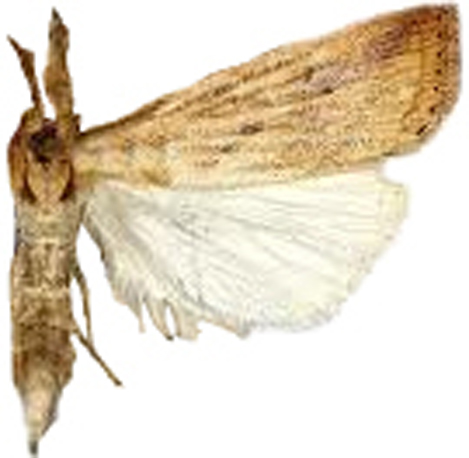
The ominously named ‘dark-headed rice borer’. The ochreous FW is strongly but variably patterned with darker patches and small black submarginal spots and a silvery submarginal fasciae. The HW is yellowish white. Females are slightly larger and paler than the males. (RTS, 1994: 163). Kapur (1964) fig. 2 gives illustrations of wing venation and Rao & Nagaraja (1965) give detailed descriptions of all stages of Chilo auricilia, C. polychysa, C. suppressalis and C. partellus.
Life History
A serious pest of rice in W. Malaysia and parts of India. Eggs are laid in batches of 20-150 in longitudinal rows on both upper and lower surfaces of the leaf. A female can lay <500 eggs. The larvae hatch after 4-7 days and can attack all stages of the rice plant. Young plants are killed and the larvae move to other stems. The pupae are formed within the stems and adults emerge after less than a week. Up to twelve overlapping generations in a year depending on climate and availability of food plants (Heinrichs & Aguda,1994; Heinrichs 1995).
References
- Bleszynski, S. & Collins, R.J. (1962). A short Catalogue of the World Species of the Family Crambidae (Lepidoptera). Acta Zool. Cracov., 7 (12): 197-389.
- Kapur, A.P. (1964) taxonomy of Rice Borers, In Major Insect Pests of the Rice Plant. Proceedings of a symposium at the International Rice Research Institute Sept. 14-18 1964 International Rice Research Institute, John Hopkins Pess, Baltimore, Maryland.