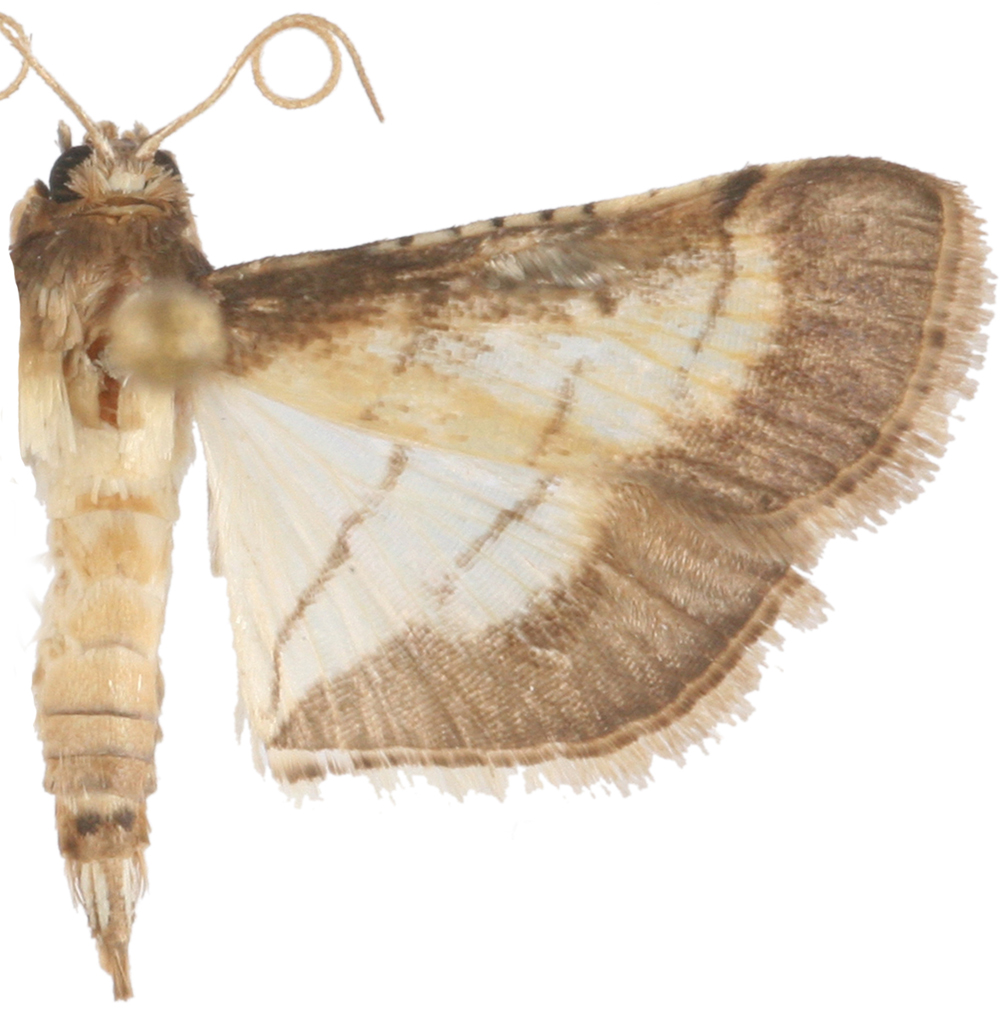
Cnaphalocrocis poeyalis Boisduval
- Family: Crambidae
- Subfamily: Spilomelinae
- Genus: Cnaphalocrocis
- Distribution: Africa to the Pacific region. Africa (Rhodesia, Nyasaland, Uganda, Nigeria), Mauritius, Bourbon Is, Madagascar, Seychelles, La Réunion, Sri Lanka, India, Nepal, W. Malaysia, Singapore, Sabah, Brunei, Sarawak, Indonesia (Java), Australia (Q, NSW). Fiji, French Polynesia. Philippines, Taiwan, China (Hong Kong).
- Habitat: Oil palm palm, cultivated areas, disturbed forest (especially young plantations) <1100m.
- Wing Length: 7.5mm
Taxonomy
The holotype of Botys poeyalis, Boisduval 1833a: 118 is from Mauritius (Bourbon Is.) TL Reunion] Comb. n. to Cnaphalocrocis Lederer 1863c (Shaffer et al. 1996).
- syn. Asopia venilialis Walker, 1859c: 373. TL Australia (Q.). Syn. n. (Marion, 1955: 76). It is the TS of Dolicisticha Meyrick, 1884b: 304;
- syn. Botys marisalis Walker, 1859d: 717 TL Sarawak (Kuching);
- syn. Marasmia cicatricosa Lederer, 1863c: 386 pl. 12, fig. 8. TL Java;
- syn. Marasmia rectistrigosa Snellen, 1872: 92, syn. n. (Shaffer et al. 1996) The male holotype from [New] Guinea is in Leiden;
- syn. Botys minutalis Mabille, 1880d: 339. TL Madagascar. Syn. n. (Marion, 1955: 78).
- syn. Marasmia hampsoni Rothschild, 1921: 227. TL W. Nigeria (Jigawa) syn. n. (Shaffer et al. 1996);
- syn. Marasmia procopia Nye (MS name). This was considered conspecific with C. poeyalis Boisduval and also C. ruralis Walker 1959d: 666 (TL Sri Lanka) by Bradley (1987) (see Bradley, 1981: 327 where it is considered a good sp.).
- syn. Asopia venialis Walker 1859c: 373, TL Australia (Moreton Bay) (TS of Dolichosticha Meyrick, 1884: 304).
Nec syn. Lasiacme mimica Warren, 1896: 177, from India, Khasia Hills [Meghalaya] The holotype is in the BMNH. It was also considered syn. in Lepindex but Shaffer notes on the same LepIndex card 'A good sp.' Here we treat it as such.
A series in the BMNHK under the name C. procopia (Nye Ms name) closely resembles C. poeyalis but the brown is much more intense this may be a var. (see illustration 2).
Description
The Lesser Rice-Leafroller adult is a pale beige coloured moth with submedian and postmedian lines across the wings. The post median line is displaced proximally to the rear of the FW like Cnaphalocrocis patnalis and C. poeyalis but unlike C. medinalis. In the male these lines are obscured centrally by a dark brown discal scale tuft. There is a broad dark brown submarginal band. The FW costa has a series of dark brown marks like some other Cnaphalocrocis spp. The abdomen is a creamy colour with abdominal segment 8 with basal band of black scales and distal band of light brown to orange scales, abdominal segment 9 with median longitudinal stripe of black scales bordered by white scales. C. mimica (Warren, 1896) has much wider, dark submarginal bands on FW & HW. The caterpillar rolls up a leaf to shelter in during the day. At maturity, the caterpillar pupates in a folded leaf of the food plant. C. mimica (Warren, 1896) has much wider bands on the FW & HW. Schulze (2000) taxon #038 & #039.
Life History
The larva feeds on leaves of grasses and sedges. They are a pest on rice plants and soy plants.
References
- Guenée, A. (1854) Deltoïdes et pyralites. In Boisduval, J.A. & Guenée, A., Hist. nat. des Insectes (Spec. gén. Lépid.) Vol. 8, 448pp. + 10 pls., Librarie Encyclopédique de Roret: Paris.
- Snellen, P. C. T. (1872) Vlinder-fauna von. Neder-Guinea, Zuidwestelijk gedeelte van Afrika. Tijdschr. v. Ent., 15: 1-110, pls. 1-8.
- Meyrick, E. (1884b) XV On the classification of the Australian Pyralidina Trans. ent. Soc. Lond. 1884 (3): 277-350.
- Rothschild, W. (1921) Captain Angus Buchanan’s air expedition V. Lepidoptera collected in Northern Nigeria and Southern Sahara in 1919-1920, Part II. Novit. Zool., 28 (2) :215-229.
- Marion, H., (1955) Synonymie de quelques pyrales décrites de Madagascar. Nat. Malagache 6: 75-78. [In French]
- Bradley, J.D. (1981) Marasmia patnalis sp. n. (Lepidoptera: Pyralidae) on rice in S.E. Asia. Bull. Ent. Res. 71 (2): 323-327.
- Bradley, J. D. (1987 unpubl.) Manuscript card catalogue of identified reared material received by Bradley for identification from about 1955 to 1987; original in BMNH Microlepidoptera Section Library.
- Shaffer, M., & Nielsen, E.S. & Horak, M. (1996) Pyraloidea (In Nielsen, E.S., Edwards, E.D. & Rangji (Eds.), Checklist of the Lepidoptera of Australia; 164-199, CSIRO, Australia.
- Walker, F. (1859d [May 10]) Pyralides, In; List Spec. Lepid. Ins. Coll. B. M., Cat. Lepid. Heterocera. Ser. 4, 18: 509-798.
- [In German]Walker, F. (1859c) Pyralides. In; List Spec. Lepid. Ins. Coll. B. M., Cat. Lepid. Heterocera. Ser. 4, 17: 255-508.
- Lederer, J. (1863c [Nov]) Beitrag zur Kenntniss der Pyralidinen. Wien. entomol. Monat. 7 (11): 379-426, pl. 2-18.
- Mabille, P. (1880d) Recensement des Lépidoptères hétérocères observés jusqu'à ce jour à Madagascar. Annales de la Société Entomologique de France 5: 291-348. [In French]
- Warren, W. (1896c) XVIII New species of moths from the Khasia Hills, Ann. Mag. Nat. Hist., Ser. 6, 18 (104): 163-177.
- Boisduval, J.B.A. (1833a) Faun. Ent. Madag. Bourbon et Maurice, Lepidopt. Roret, Paris. 122 pp., 16 pls. [in French]
- Lederer, J. (1863a [Aug]) Beitrag zur Kenntniss der Pyralidinen. Wien. entomol. Monat. 7 (8): 243-280, pl. 2-18.