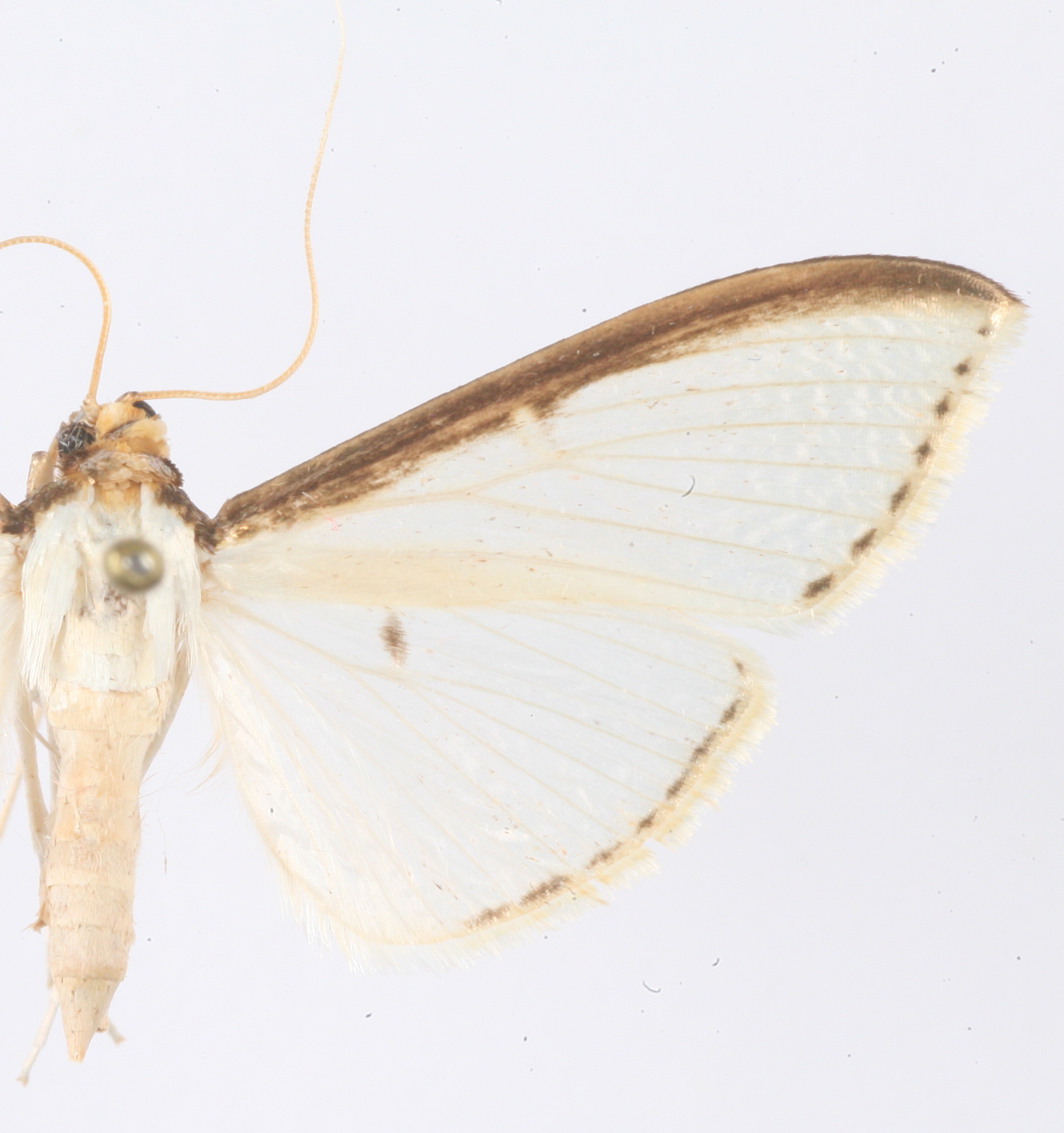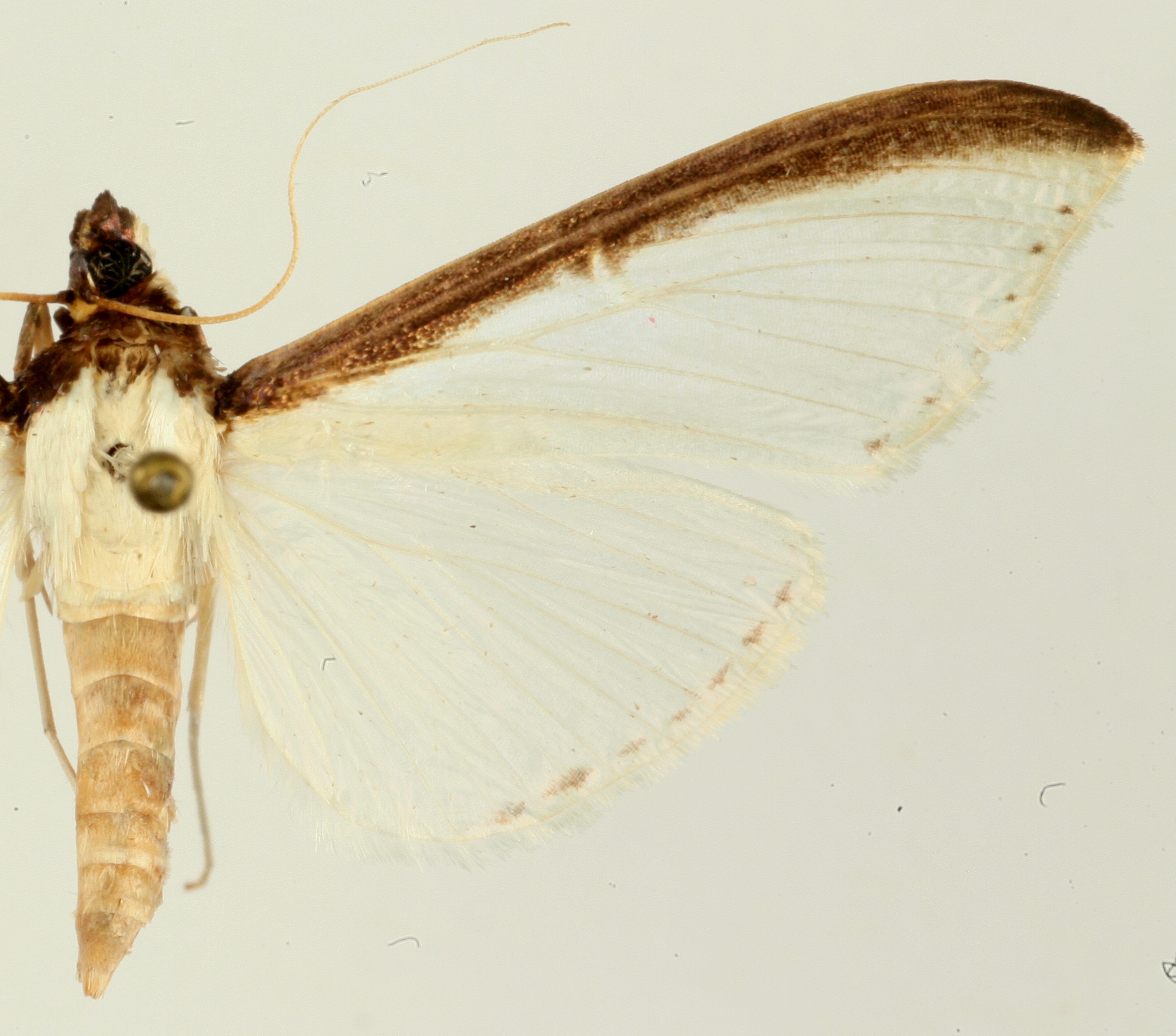
Cydalima laticostalis Guenée
- Family: Crambidae
- Subfamily: Spilomelinae
- Tribe: Margaroniini
- Genus: Cydalima
- Distribution: Pakistan, Sri Lanka, India (Maharashtra, S., Sikkim, Assam, W. Bengal, Andaman Is.), Bangladesh, Burma, Thailand, W. Malaysia, Singapore, Kalimantan Berat, Sabah, Brunei, Sarawak, Sumatra, Java, Sumbawa, Sulawesi, Mollucas, Irian Jaya) PNG, New Hebrides, Australia, Samoa, China.
- Habitat: Lowland to lower montane forest <1580m
- Wing Length: 17mm
Taxonomy
The holotype of Margarodes laticostalis Guenée, 1854: 303, pl. 8 fig. 9, is from Bengal [Bangladesh (Sylhet)].
Comb. n. to Cydalima Lederer, 1863: 397 Syn. n. (Shaffer et al. 1996).
- Syn? Margarodes conchylalis Guenée, 1854: 303, pl. 8, fig. 9. The T.S. of Cydalima Lederer, 1863. Syn. n. (Hering 1901: 240-241);
- syn. Margarodes nitidicostalis Guenée, 1854: 303. TL Sillet [Sylhet]. Syn. n. (Hampson 1896: 346 (confirmed by Shaffer et al. 1996);
- syn. Margaronia leodicealis Walker, 1859d: 530-531. TL India (Hindustan, ‘Hindostan’). Syn. n. Moore 1877: 618. As syn. (Shaffer et al. 1996).
Here we treat laticostalis Guenée as being defined by the absence of a spot on the HW as Guenée makes no mention of any such spot in his descriptions of both laticostalis and conchylalis.
We treat the spotted morphotypes as Cydalima sp. 8.
The RTS specimen (Pl. 32 fig. 7) from Thailand has a small spot on the HW but several specimens of synonymised spp., in several collections, lack this spot and this needs closer investigation as it may be that some morphotypes with a very faint HW spot may represent other covert spp.
Description
The broad dark brown subcosta is the only colour on the almost transparent wings of this pearly white sp. It remains constant in width right to the FW apex. Medially, the anterior margin of the subcostal shading is interupted by an poorly defined patch . Some specimens have purple or brassy iridescence. There are a distinct elongated grey-brown spots on the FW & HW termenae. According to RTS (1994: 187) the males have short dark hair scales on pale valvae and antenae with a slight dilation near the base followed by a series of short spines but we haven’t been able to verify this. However the spotted Cydalima sp. 8 does have black anal hair pencils. Schulze (2000) similarly differentiated between these two morphotypes as Taxon # 931[treated as C. conchylalis] with a spot & taxon #929 [C. laticostalis] without a spot. Those with the spot resemble the DNA barcoded specimen of C. laticostalis in BOLD sample ID: USNM ENT 00798368 from Papua New Guinea, those without, resemble the BOLD sample ID: #19495.jpg
Life History
Feeds on the leaves of Flacourtia spp. (Salicaceae).
References
- Guenée, M. A. (1854) Deltoïdes et pyralites. In Boisduval, J.A. & Guenée, A., Hist. nat. des Insectes (Spec. gén. Lépid.) Vol. 8, 448pp. + 10 pls., Librarie Encyclopédique de Roret: Paris.
- Lederer, J., (1863) Beitrag zur Kenntniss der Pyralidinen. Wien. entomol. Monat. 7: 243-280, 331-502, pl. 2-18.
- Robinson, G. S., Tuck, K. R. & Shaffer, M. (1994) A Field Guide to the Smaller Moths of South-East Asia, Malaysian Nature Society Kuala Lumpur & Natural History Museum, London, 311 pp. 51 text figs, 32 pls.
- [RTS] Robinson, G, S., Tuck, K. R. & Shaffer, M. (1994): 187, Pl. 32 fig. 7.
- Shaffer, M., & Nielsen, E.S. & Horak, M. (1996) Pyraloidea (In Nielsen, E.S., Edwards, E.D. & Rangji (Eds.), Checklist of the Lepidoptera of Australia; 164-199, CSIRO, Australia.
- Schulze, C.H. (2000) Auswirkungen anthropogener Störungen auf die Diversität von Herbivoren. (Analys von Nachtfalterzönosen entlang von Habitatgradienten in Ost-Malaysia). Unpubl. PhD Thesis, University of Bayreuth, Germany, 350pp.
- Ratnasingham, S. & Hebert, P.D.N.(2007) Barcoding - BOLD: The Barcode of Life Data System (www.barcodinglife.org), Molecular Ecology Notes (Journal compilation © 2007 Blackwell Publishing Ltd.: 10 pp.
- Walker, F. (1859d [May 10]) Pyralides, In; List Spec. Lepid. Ins. Coll. B. M., Cat. Lepid. Heterocera. Ser. 4, 18: 509-798.
- Walker, F. (1865c [Oct 14]) List Spec Lepid. Ins. Coll. B. M., Cat. Lepid. Heterocera. 33, (Suppl. 3): 707-1533.