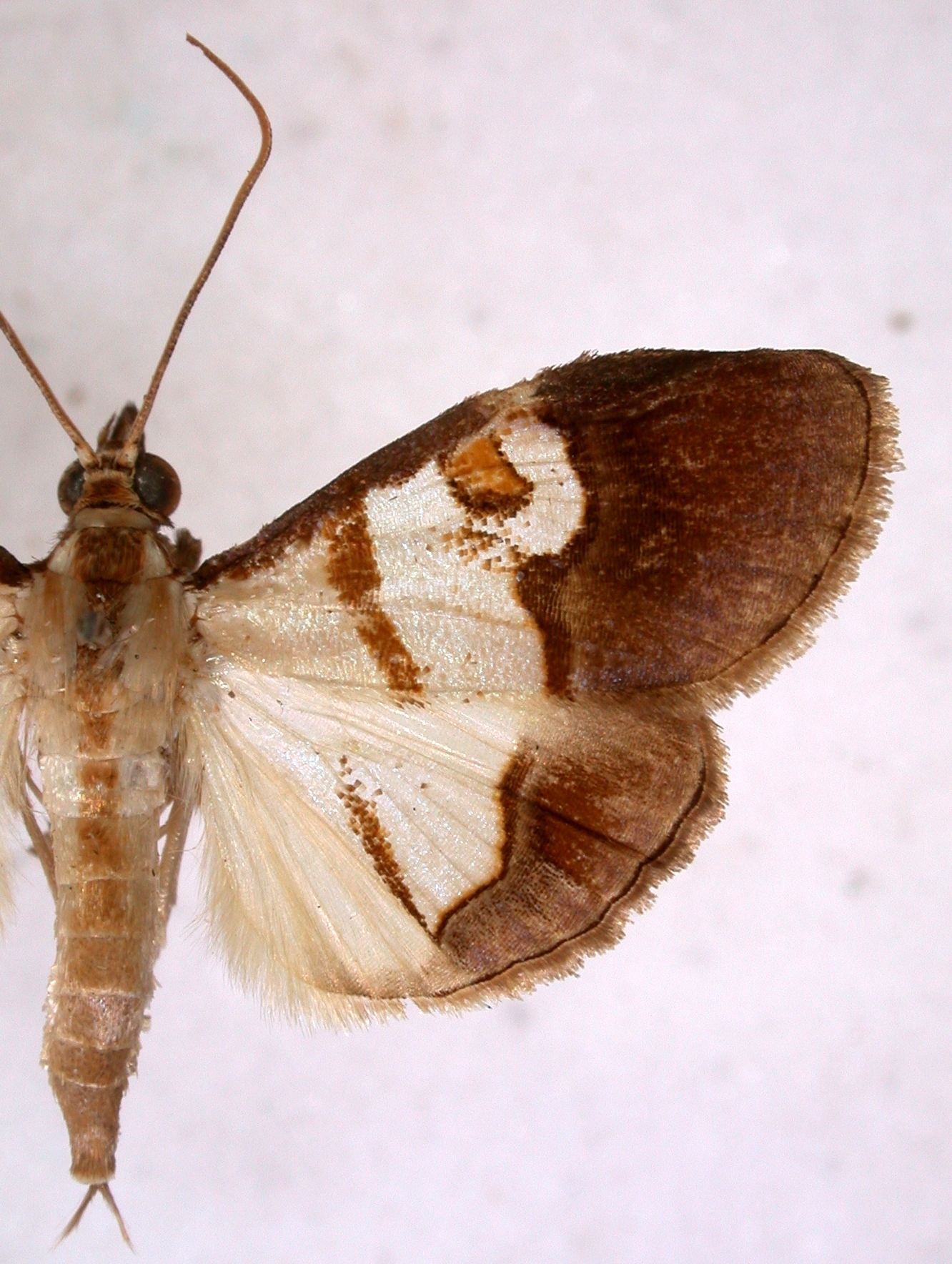
Dausara sp. 1
- Family: Crambidae
- Subfamily: Odontiinae
- Genus: Dausara
- Distribution: India, Laos, Thailand, Sabah.
- Habitat: Lowland forest
- Wing Length: 13mm
Taxonomy
Dausara sp. 1 is represented by a series in the BMNH separated out by Munroe [Munroe's 'species 3']. Yoshiyasu (1995) may be confusing this morphotype with D. talliusalis.
Description
In this sp. the antemedian line of the FW is linear in contrast with all Dausara spp. (except the female of Dausara chiangmai Yoshiyasu) which have triangular fasciae RTS (1994: 177) stated that D. talliusalis Walker, 1859: 507 usually has a distinct yellow tint with a golden brown discocellular spot but the holotype shows little evidence of that; it being more similar to the D. marginalis = amethysta types. Perhaps they were refering to this undescribed Dausara sp. 1 which at that time was included with D. talliusalis. The abdomen is a pale pinkish at the tip becoming pinkish white on the sides towards the thorax which laterally, is covered by long pale pinkish brown tegulae. Along the centre from thorax to abdomen is a diffuse fulvous line. Schulze (2000) Taxon #645 (single specimen) as Dausara taliusalis Yoshiyasu, (1995) gives a key to 3 Thai Dausara spp..
References
- Moore, F. (1877) The Lepidopterous Fauna of the Andaman & Nicobar Islands. Proc. zool. soc. Lond: 580-632, pls. 58-60.
- [RTS] Robinson, G.S., Tuck, K.R. & Shaffer, M. (1994) A Field Guide to the Smaller Moths of South-East Asia, Malaysian Nature Society Kuala Lumpur & Natural History Museum, London, 311 pp. 51 text figs, 32 pls.
- Yoshiyasu, Y., (1995) The Genus Dausara Walker of Thailand (Lepidoptera: Pyralidae), Microlepidoptera of Thailand, 3 (July 31, 1996); 93-103, Figs. 1-8.
- Schulze, C.H. (2000) Auswirkungen anthropogener Störungen auf die Diversität von Herbivoren. (Analys von Nachtfalterzönosen entlang von Habitatgradienten in Ost-Malaysia). Unpubl. PhD Thesis, University of Bayreuth, Germany: 350 pp.
- Walker, F. (1859c) Pyralides. In; List Spec. Lepid. Ins. Coll. B. M., Cat. Lepid. Heterocera. 17: 255-508.