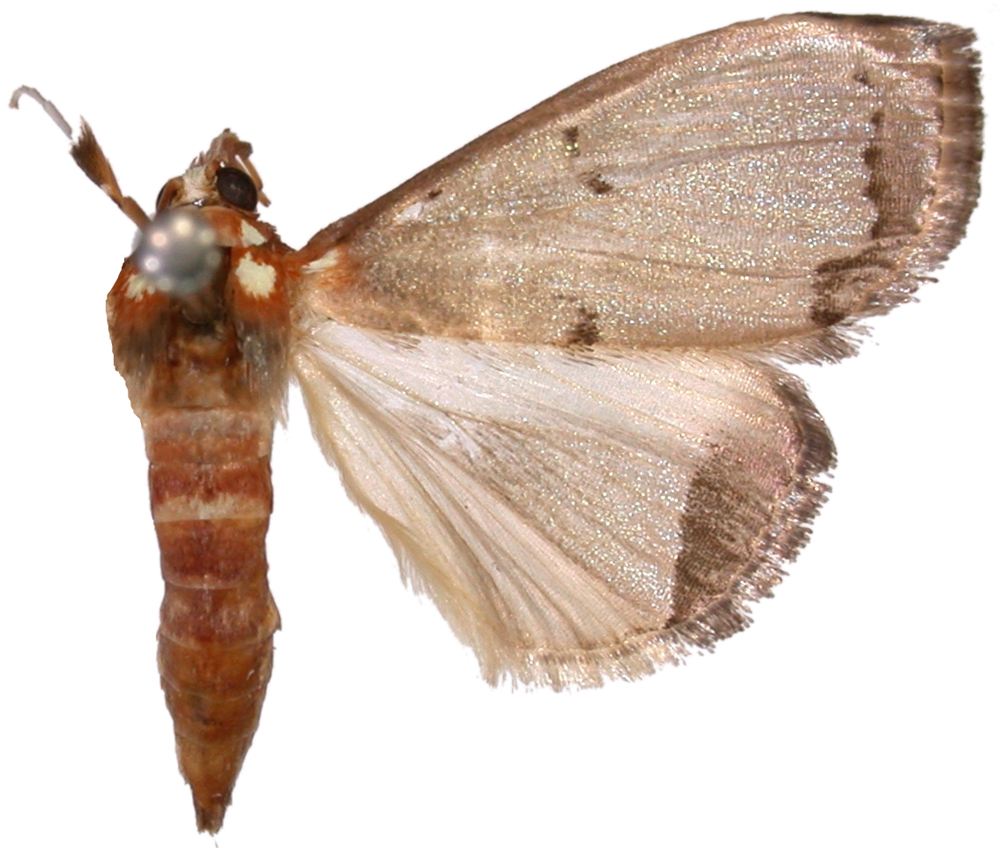
Deanolis sublimbalis Snellen
- Family: Crambidae
- Subfamily: Odontiinae
- Genus: Deanolis
- Distribution: India (W. Bengal), Myanmar, Thailand, Sabah, Brunei, Java, Sulawesi, Irian Jaya, PNG, Torres Strait (Dauan Is, Saibai Is), Australia (Q introd.) India (West Bengal), China (Yunnan), Philippines.
- Habitat: Lowland to lower montane; <1220m.
- Wing Length: 14mm
Taxonomy
The male lectotype (selected by Munroe et al. 1957) of Deanolis sublimbalis Snellen, [1900] 1899: 71, pl. 3 fig. 11,12, from Sulawesi (Makassar), is in Leiden.
- ms [junior subjective] syn. Noorda albizonalis Hampson, 1903: 219. TL India (Darjeeling). Shaffer (1992 [Lepindex]) & Shaffer pers. com. in Waterhouse (1998: 106)
A note by Shaffer, 1997 (LepIndex card) suggests Sceliodes iriocapna Meyrick 1938: 82, TL Indonesia (Djokjakarta) is also syn. but here we treat it as a good sp.
Description
A pale brown-purple sp. with darker marginal patches. The FW has two small central spots and another larger spot on the distal edge. The body is red brown with bright yellow spots on the thorax. On some specimens these yellow spots are less obvious.
Life History
‘The red-banded mango caterpillar’ or ‘mango seed borer’. Eggs are typically laid on fruit of marble size. After 3 to 4 days, larvae hatch and burrow into the distal end of the mango fruit. Larvae pass through five instars within the fruit, with a larval development period of 14-20 days (Golez 1991). A pest of Anacardiaceae whose larvae tunnel in the flesh and seeds of mango fruit (Mangifera indica). This is the commonest host, but there are records also from M. odorata (Papua New Guinea & Indonesia, M. minor (PNG) (F. Dori pers. comm. 1997 in Waterhouse 1998: 108) and Bouea burmanica (Thailand) (Beller & Bhenchitr 1936), (India) (Sengupta and Behura 1955); (Indonesia) (Kalshoven 1981). As the genus Mangifera contains many spp. it is probable that further wild hosts will be found (Fenner 1997).
References
- Snellen, P.C.T. ([1900] 1899) Nieuwe aanteekeningen over Pyraliden Tijdschr. v. Ent. 42 : 58-114, pls. 3 & 4.
- Beller, S. and Bhenchitr, P. (1936) A preliminary list of insect pests and their host plants in Siam. Technical Bulletin 1. Department of Agriculture and Fisheries, Bangkok, Siam.
- Sengupta, G.C. and Behura, B.K. (1955) Some new records of crop pests from India. Ind. J. of Entomol. 17: 283-285.
- Munroe, E.G., Diakonoff, A. & Martin, E.L. (1958) Catalogue of Snellen’s types of Pyralidae with selections of lectotypes. Tijdschr. v. Ent., 101 (2): 65-88.
- Kalshoven, L.G.E. (1981) The Pests of Crops in Indonesia. Rev. & transl. by Van der Laan, P.A & Rothschild, G.H.L. Ichtiar Baru-Van Hoese, P.T., Jakarta, Indonesia, 701pp.
- Golez H.G. (1991) Bionomics and control of the mango seed borer, Noorda albizonalis Hampson (Pyralidae: Lepidoptera). Acta Horticulturae 291, 418-424.
- Fenner, T.L. (1997) Red-banded mango caterpillar: biology and control prospects. Mango Care Newsletter, 2pp. Queensland.
- Waterhouse D.F. (1998) Biological control of insect pests southeast Asian prospects. Australian Centre for International Agricultural Research, Canberra. 548pp.
- Meyrick, E. (1938a) Deutsche ent. Zeitschr. ‘Iris’ zu Dresden, 52: 73-88.
- Hampson, C.F. (1903b) The Moths of India Supplementary paper to the Volumes in “The Fauna of British India” Series II part X with pls. C. J. Bombay Soc., 15: 106-226.