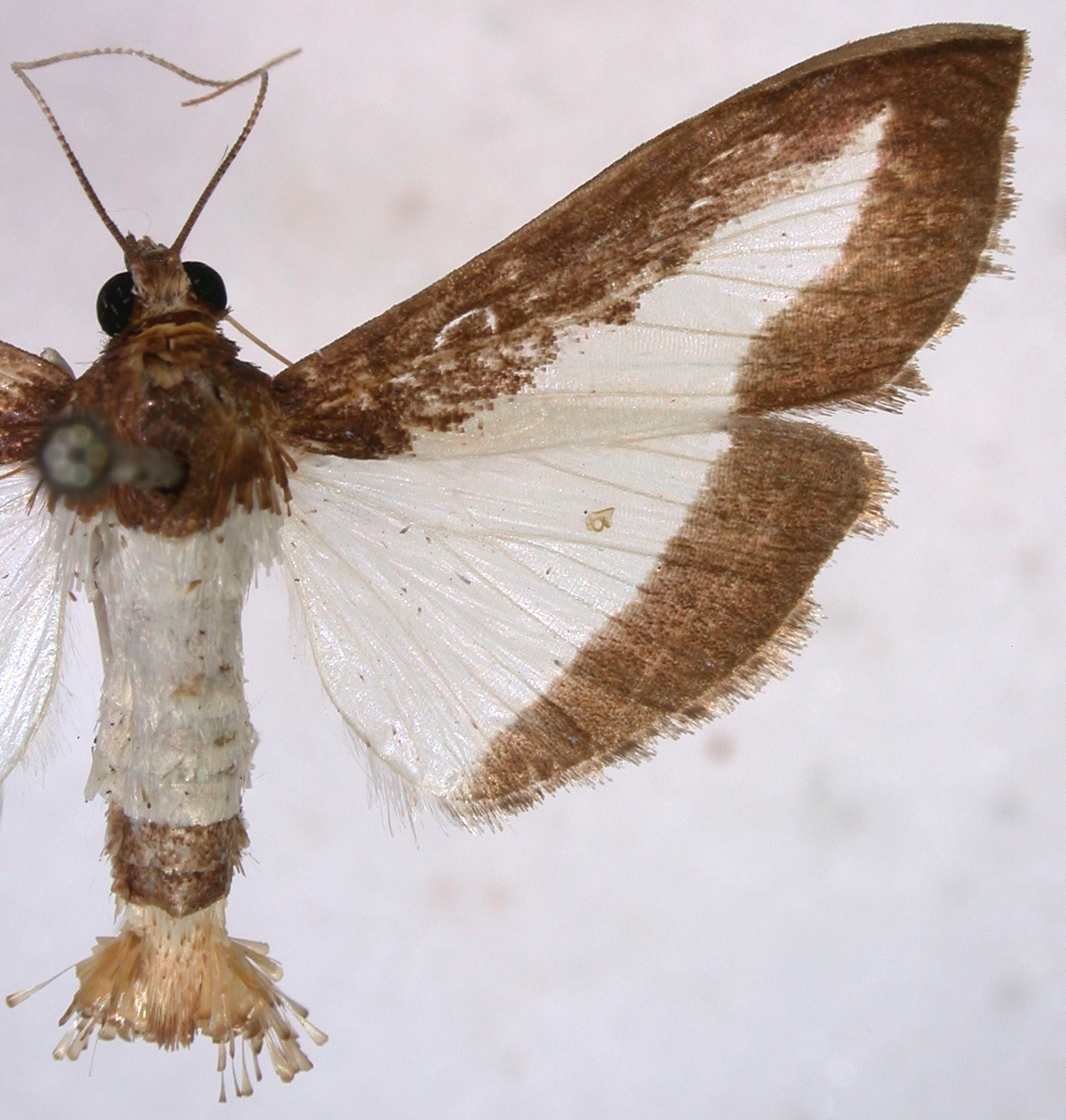
Diaphania indica Saunders
- Family: Crambidae
- Subfamily: Spilomelinae
- Tribe: Margaroniini
- Genus: Diaphania
- Distribution: USA, S. America (Venezuela, French Guiana, Paraguay), Caribean (Cuba, Jamaica, Puerto Rico, Dominican Republic, West Indies), Africa (Ethiopian region, sub-Sahara, Cameroon, Comoros, Congo, Ethiopia, Gambia, Kenya, La Reunion, Malawi, Mozambique, Nigeria, Rwanda, Sierra leone, S. Africa, Sudan, Tanzania, Zimbabwe, Madagascar, Mauritius,), Middle East (Saudi Arabia, Yemen), Pakistan, Sri Lanka, India (Uttar Pradesh, Maharastra, Nilgiris,West Bengal, Sikkim, Niccobar Is., Andaman Is), Bangladesh, Burma, Thailand, W. Malaysia, Sabah, Brunei, Indonesia (Kalimantan Berat, Java, Sulawesi). China (Hong Kong), Taiwan, S. Korea, Japan. PNG, Australia (NT, Q, NSW), Seychelles, Christmas Is., Samoa, Solomon Is.. Lowland primary & disturbed forest & cultivated areas <460m in Borneo, <200m in PNG (Novotny <i>et al</i>.
- Habitat: 2005)
- Wing Length: 12.5mm
Taxonomy
The lectotype of Eudioptes [Sic] indica (Saunders, 1851: 163-164 pl. 12 figs 5-7) is in the Oxford UMNH. The lectotype designated by Clarke (1986: 78-80) is from Indonesia (Java).
- syn. Eudioptis capensis (Zeller, 1852: 52) orig. mispel. TL S. Africa (Bosjesmansrand) male type in SBMNH;
- syn. Phakellura gazorialis Guenée, 1854: 297. TL Indonesia (Java) = garorialis Snellen, 1882: (Misspell.);
- syn. Phakellura zygaenalis Guenée, 1854: 297. TL [Israel / Palestine] Judea;
- syn. Phakellura curcubitalis Guenée, 1862: 64. TL Reunion Is.;
- syn. Glyphodes intermedialis Dognin, 1904: 129. TL Paraguay;
- syn. Botys hyalinalis Boisduval, 1833: 117. TL Madagascar.
In LepIndex as Cryptographis Lederer 1863: 399 but is also referred to Palpita Hübner, 1808 by some authors. Here we use the generally accepted placement in Diaphania Hübner, 1818, supported by Mally & Nuss (2010) (Globiz). Schulze (2000) Taxon #567.
Description
This shining white sp. with black wing margins and a black and white body is highly distinctive. Diaphania hyalinata Linn. appears to be readily confused with D. indicata but as Clavijo & Munroe, (1991) point out, it is readily distinguished by having a white spot in the discal cell.
Life History
An adventive pest in the tropics & subtropics. Up to four generations per year in China. Females are highly fecund and lay 340 -1,050 eggs depending upon the time of year the adults emerge (Ke et al., 1986, 1988). Eggs are laid singly or in groups on the underside of leaves. Saunders (1951) illustrates the larvae and the pupa. The caterpillar is green with a pale line along each side of its back with a yellow head and a 'grass-green' mouth. Known as a pest of cotton Gossypium herbaceum (malvacea) for many years the pumpkin or melon caterpillar, is also an important pest of cucurbitaceous vegetables including, Cucunis pepo (pumpkin), Cucumis sativus (cucumber), Cucumis melo (melon), Luffia acutangula (angled luffa), Luffia aegyptiaca (luffa sponge gourd), Trichosanthes cucumerina var. anguina, (snake gourd or tomato), Trichosanthes hupehensis (= palmata) & Achyranthes aspera devil's horsewhip) (Amaranthaceae). Also found on Erythrina corollodendron (coral tree or dadap) (Fabacea) in Java (Pandy 1977). For a much longer list of foodplants pest status and control see CSL (2005) (available on line).
References
- Hübner, J. ([1818-1837] 1818) Zuträge zur Sammlung exotischer Schmettlinge bestehend in Bekundigung einzelner Fliegmuster neuer oder rarer nichteuropäischer Gattungen, 1: 40 pp. pls. 1-35, figs. 1-200. Augsburg. [In German]
- Gates-Clark, J.F. (1986) Pyralidae and Microlepidoptera of the Marquesas Archipelago. Smithsonian Contr. Zool. Smithsonian Institution Press, Washington.416, iii + 485pp. CSL (2005) Pest Risk Analysis for Diaphania indica. Central Science Laboratory, Sand Hutton, York, YO41 1LZ UK. Boisduval, J.B.A. (1833a) Faun. Ent. Madag. Bourbon et Maurice, Lepidopt. Roret, Paris. 122 pp., 16 pls. [in French] Dognin, P. (1904) Hétérocères nouveaux de l' Amérique du Sud. Ann. Soc. ent. Belgique, 48: 115-134. Guenée A. M. (1862) Lépidoptères. In: Maillard, L., Notes sur l' île de la Réunion (Bourbon) (Annexe G):1-72; pls. 12-13. Guenée, M. A. (1854) Deltoïdes et pyralites. In Boisduval, J.A. & Guenée, A., Hist. nat. des Insectes (Spec. gén. Lépid.) Vol. 8, 448pp. + 10 pls., Librarie Encyclopédique de Roret: Paris. Ke, L. D , Li, Z. Q., Xu, L. X., Zheng Q. F. (1986) A brief report of a study on Diaphania indica. Zhejiang Agricultural Science, 3: 139-142. Ke, L. D , Li, Z. Q., Xu, L. X., Zheng Q. F. (1988) Host plant preference and seasonal fluctuation of Diaphania indica Saunders. Acta Entomologica Sinica, 31 (4) :379-386. Mally, R & Nuss, M (2010) Phylogeny and nomenclature of the box tree moth, Cydalima perspectalis (Walker, 1859) comb. n., which was recently introduced into Europe (Lepidoptera: Pyraloidea: Crambidae: Spilomelinae), Eur. J. Entomol. 107: 393–400. Novotny, V., Miller, S. E., Basset, Y., Darrow, K. and Weiblen, G. D. (2005) Caterpillars feeding on New Guinea plants - online. Published at www.entu.cas.cz/png/caterpillars/ Pandey, P.bN. (1977) Host preference and selection of Diaphania indica Saunders (Lep., Pyralidae) Dt. ent. Z., Iris, Dresden, 24, (1-3): 159-173. [RTS] Robinson, G, S., Tuck, K. R. & Shaffer, M. (1994): 188, Pl. 31 fig. 7. Saunders, W. W. (1851) XVIII Insects injurious to the cotton plant. Trans. ent. Soc. Lond.: 158-166 , pl. 12. Zeller, P. C. (1852) Lepidoptera Microptera quae J. A. Wahlberg in Caffrorum terra legit, Stockholm: P. A. Norstedt & Söner. pp. 120.
- Clavijo, J. A. & Munroe, E. M. (1991) Misidentification of Diaphania hyalinata L. (Lepidoptera: Crambidae, Pyraustinae) in the British Lepidopteran fauna. Br. J. Ent. Nat. Hist, 4, 9-10.
- Robinson, G. S., Tuck, K. R. & Shaffer, M. (1994) A Field Guide to the Smaller Moths of South-East Asia, Malaysian Nature Society Kuala Lumpur & Natural History Museum, London, 311 pp. 51 text figs, 32 pls.
- Lederer, J. (1863b [Oct]) Beitrag zur Kenntniss der Pyralidinen. Wien. entomol. Monat. 7 (10): 331-378, pl. 2-18.