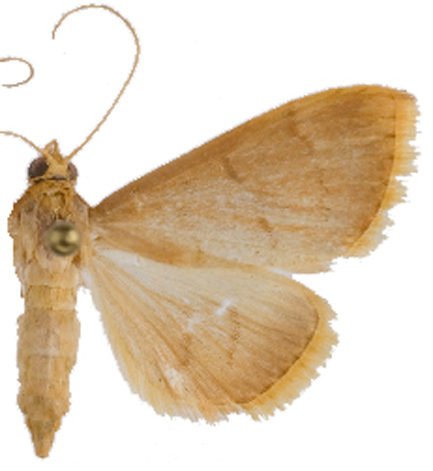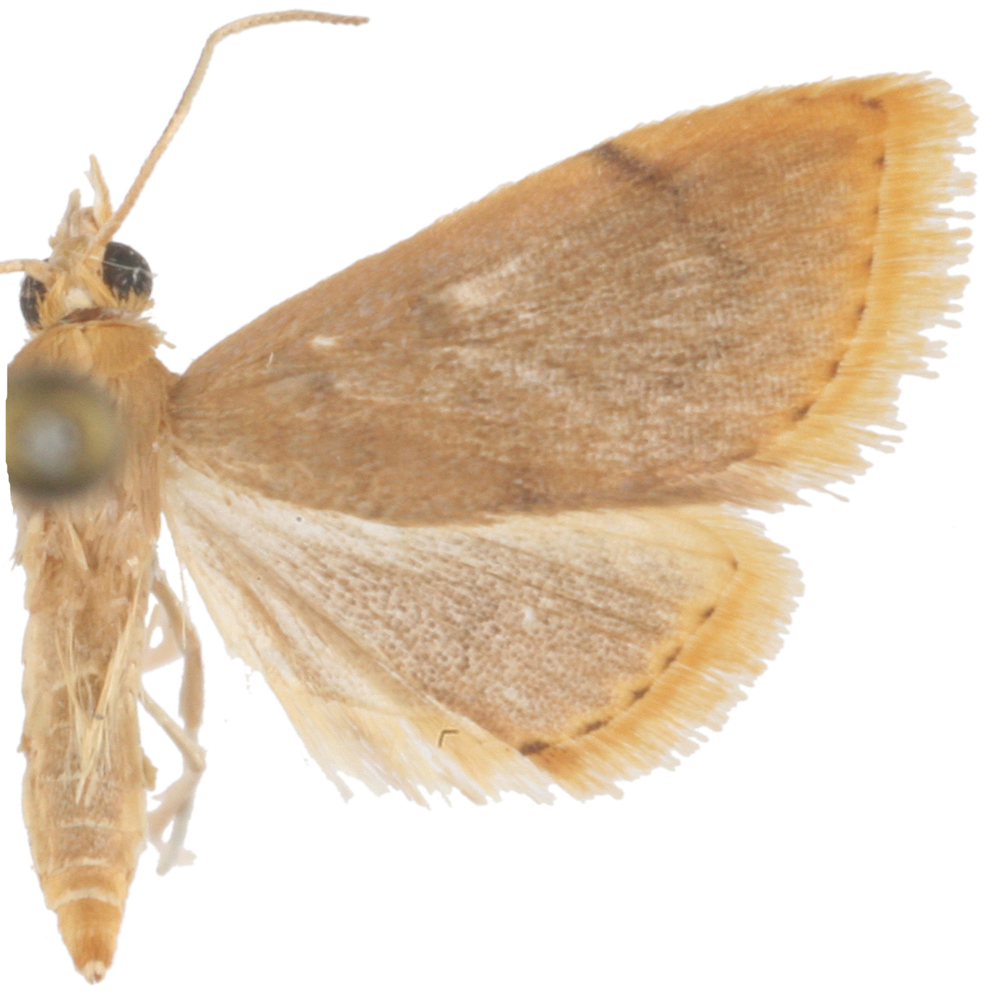
Lepidoplaga flavicinctalis Snellen
- Family: Crambidae
- Subfamily: Pyraustinae
- Genus: Lepidoplaga
- Distribution: Sri Lanka, India (Sikkim, Assam, Meghalaya) Thailand, W. Malaysia, Sabah, Indonesia (Java), China.
- Habitat: Lowland disturbed forest & cultivated areas <520m.
- Wing Length: 7mm
Taxonomy
The male holotype of Crocidophora flavicinctalis Snellen, 1890: 595 is in the BMNH. TL Assam [Meghalaya] (Khasia Hills).
- syn. Lepidoplaga elongalis Warren, 1896b: 108; syn. n. (Swinhoe 1901: 138);
- syn. Lepidoplaga longicorpus Warren, 1896b: 108.; TL India [Meghalaya] Khasias;
- syn. Mabra flavofimbriata Moore 1888 [1889]: 208. TL India [Meghalaya] Khasia & Jaintia Hills. A lectotype is in the BMNH. mentioned by Warren, 1896b: 108, syn. n. (Swinhoe 1901: 138)
- syn? Crocidophora? flavicillialis Snellen 1890 (:596, Pl. XX, figs. 5 & 5a). 596–597, pl. 20 figs 5–5a. TL India, Sikkim. The type is in the BMNH; Snellen considered it mainly differed from flavicinctalis by the absence of the underside depression in the discal cell and the length and brightness of its yellow fringes.
- syn. Pionea chromalis (Caradja, 1925: 366) TL China as a ssp.
Snellen provisionally placed this sp. in Crocidophora Lederer as being closely related to spp. of that genus but he did not have access to any of Lederer’s specimens (Snellen 1890, 595-596).
It is the TS of Lepidoplaga Warren 1895: 475. Gen. rev. (Maes 1994).
Schulze (2000) Taxon #722 ‘spilomelini sp. 135’
Description
The wings are mainly a rich pinkish brown with a violet sheen. The wing margins are ochreous yellow, narrowly on the costa and wing margins broader near the FW apex. The discal cell has a pale patch which marks a depressed area on the paler gray underside. There is an indistinct post basal line. Two thirds along the FW costa is a grey-brown spot marking the start of the looped second brownish line. This continues as a curving diffuse median line across the HW. Both FW & HW have neural spots at the margin. Description after Snellen 1890: 595.
Many morphotypes have very faint patterning and reduced spots. The markings of the type of L. elongalis are practically obsolete. L elongalis has white fore tarsi whereas in L. longicorpus they are yellow. These differences might merit a reassessment of their syn. status. Addition complications are that there is marked sexual dimorphism with the males having very elongate abdomens.
See also Ecpyrrhorrhoe rubellalis (Snellen) which is superficially similar in colour and patterning but slightly larger.
References
- Hewitson, W.C. & Moore. F. (1879 -1888 [1889]) Descr. new Ind. Lepid. Ins.. Colln. late Mr. W.S.Atkinson, Asiatic Soc. Bengal, Taylor & Francis, London.
- Snellen, P. C. T. (1890) XVIII A catalogue of the Pyralidina of Sikkim collected by Henry J. Elwes and the late Otto Möller. Trans ent. Soc Lond: 557-647, 2 pl. (XIX & XX).
- Warren, W. (1895) LXIV New species of Pyralidae, Thyridiae and Epiplemidae. Ann. Mag. Nat. Hist. Ser. 6, (16) (96): 460-477.
- Caradja (1925) Euber Chinas Pyraliden, Tortriciden, Tineiden nebst kurze Betrachtungen, zu denen das Studium dieser Fauna Veranlassung gibt Acad. Romana Mem. Sect. Stiint. ser. iii, 3 (7): 257-383, figs.
- Maes, K. V. N. (1994) Some notes on the taxonomic status of the Pyraustinae (sensu Minet 1981 [1982]) and a check list of the Palearctic Pyraustinae (Lepidoptera, Pyraloidea, Crambidae). Ann. Soc. Roy. Entomol. Belg. 130: 159-168.
- Schulze, C.H. (2000) Auswirkungen anthropogener Störungen auf die Diversität von Herbivoren. (Analys von Nachtfalterzönosen entlang von Habitatgradienten in Ost-Malaysia). Unpubl. PhD Thesis, University of Bayreuth, Germany, 350pp.
- Walker, F. (1859e) Pyralides, In; List Spec. Lepid. Ins. Coll. B. M., Cat. Lepid. Heterocera. Ser. 4, 19: 799-1036.
- Warren, W. (1896b) XVI New species of moths from the Khasia Hills, Ann. Mag. Nat. Hist., Ser. 6, (18): 107-119.
- Swinhoe, C. (1901d) XX New and little-known moths from India and Australia, Ann. Mag. nat. Hist. (Ser. 7) 8: 123-139.