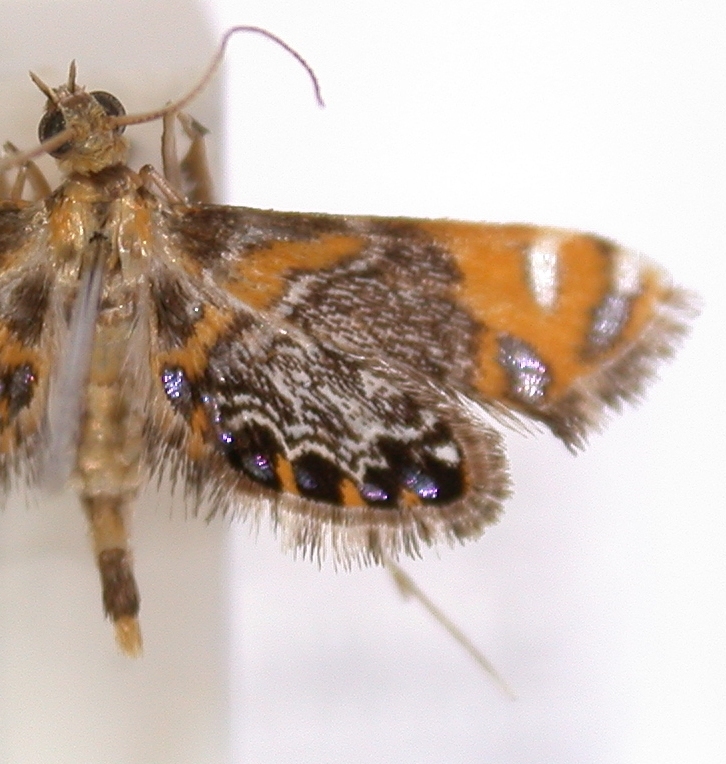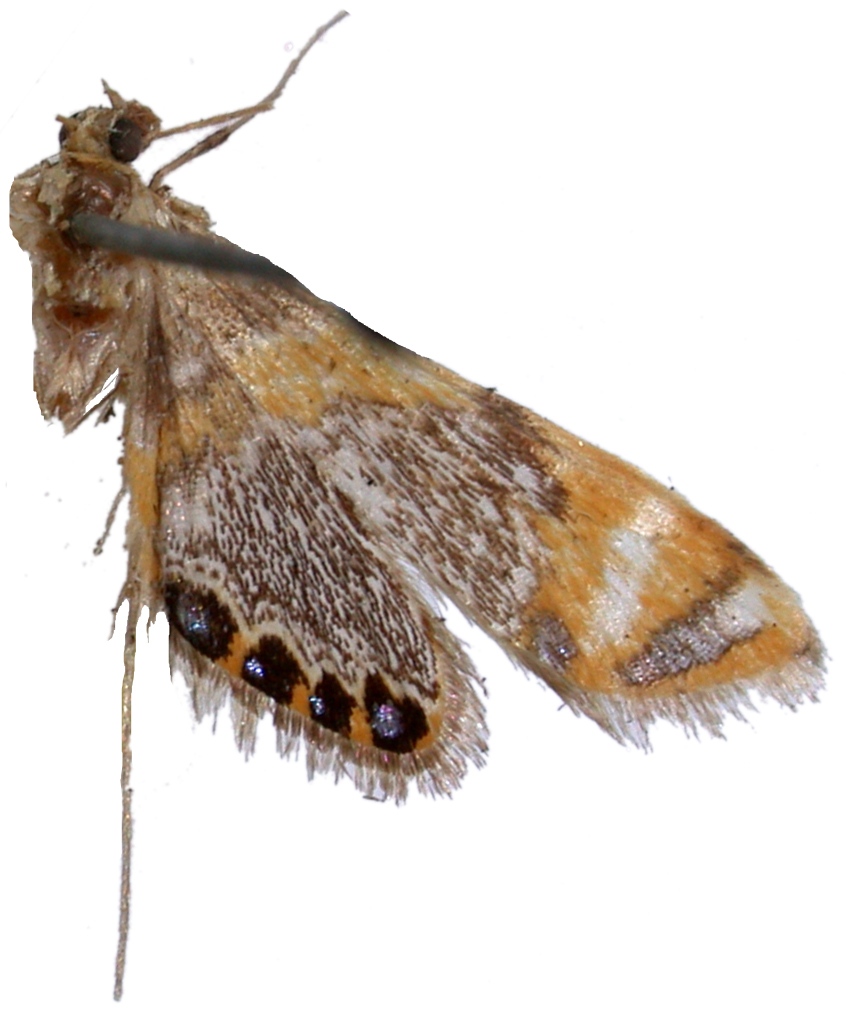
Nymphicula blandialis Walker
- Family: Crambidae
- Subfamily: Acentropinae
- Genus: Nymphicula
- Distribution: Sri Lanka, India (W. Bengal), Sabah, Philippines, Japan.
- Habitat: No verified habitat info.
- Wing Length: 7mm
Taxonomy
The holotype of Cataclysta blandialis Walker, 1859c: 488. is from Sri Lanka.
- syn. Nymphicula stipulalis Snellen (1880) [orig. descript.] Snellen [1880] 1880-1892: 78, pl. 5 fig. 11, TS of Nymphicula. The lectotype from Sulawesi (Maros) selected by Munroe et al. 1958: 85, is in Leiden.
- Syn. n. (Klima, 1937).
- syn. Cataclysta cuneifera Moore, [1885] 1884-7: 300, pl. 179, fig. 14, TL: [Sri Lanka] Ceylon.
- Comb. n. to Nymphicula (Speidel & Mey, 1999).
Cataclysta junctalis Hampson 1891: 140, pl.155, fig. 24. was treated as syn. until Yoshiyasu showed that Hampson’s Japanese blandialis specimens were distinct. Stat. Rev. as a good sp. (Yoshiyasu 1980:13-18).
Nymphicula mesorphna (Meyrick, 1894b: 10) is not considered syn. by Agassiz (note on LepIndex Card).
Description
This species has typical Nymphicula (sensu Yoshiyasu, 1980) patterning in dark brown, fulvous and white with leaden patches. Densely speckled brown occupies the centre of both wings, that of the HW separated by a serrate subterminal line from four, spectacular electric blue-centred eyespots, on the wing margin. It shares its general patterning with Nymphicula kinabaluensis Mey and Nymphicula sp. 2 but is larger. Note the white post median patch from the FW costa is different in all three spp.. and N. kinabaluensis has five eyespots as does N. junctalis. N. saigusai Yoshiasu, 1980: 6-13, TL Japan (Honshu, Fukuoko ] is very similar with four eyespots but differs in its wing venation and the shape of the FW tornal marking.
Life History
It is possible that the larvum is a terestrial case-bearer like N. saigusai Yoshiyasu which feeds on mosses. Conway (1971) reports it as a suspected pest of cocoa which appears unlikely.
References
- Snellen, P.C.T. (1880-1892) Lepidoptera. In Veth, P. J., (1880-1892). Midden-Sumatra. 4 (8). 92 pp., 5 pl. Leiden.
- Snellen, P.C.T., (1880) Nieuwe Pyraliden op het eiland Celebes gevonden door Mr. M. C. Piepers. Tijdschr. v. Ent., 23: 198-250.
- Moore, F. ([1885] 1884-7) Lepid. Ceylon 3: 578pp., pl. 144-215. London.
- Hampson,G.F. (1891) The Lepidoptera Heterocera of the Nilgiri district. Ill. typ. spec. Lepid. Heteroc. coll. B.M., 8. iv + 144 pp., pl. 139-156, Taylor & Francis, London.
- Munroe, E.G., Diakonoff, A. & Martin, E.L. (1958) Catalogue of Snellen’s types of Pyralidae with selections of lectotypes. Tijdschr. v. Ent., 101 (2): 65-88.
- Conway, G.R. (1971) Pest [sic] of Cocoa in Sabah and their control. Kementerian Pertanian dan Perikanan Sabah, Malaysia [State Ministry of Agriculture and Fisheries (Sabah, Malaysia)]
- Yoshiyasu, Y., (1980) A systematic study of the genus Nymphicula Snellen from Japan (Lepidoptera: Pyralidae) Tyo to Ga. Butterflies and Moths 31: 1-28.
- Mey, W. (2009) New aquatic moths from high elevations of Mt. Kinabalu in northern Borneo (Lepidoptera: Pyraloidea, Acentropinae). Ent. Zeitschr., Stuttgart, 119 (3) 99 -107.
- Walker, F. (1859c). Pyralides. In; List Spec. Lepid. Ins. Coll. B. M., Cat. Lepid. Heterocera. 17: pp. i-iiv, 255-508.
- Speidel, W. & Mey, W. (1999b) Catalogue of the oriental Acentropinae (Crambidae, Pyralidae). Tijdschr. v. Entomol. 142: 125-142, figs. 1-3.