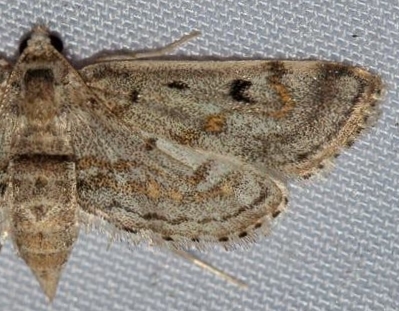
Parapoynx crisonalis Walker
- Family: Crambidae
- Subfamily: Acentropinae
- Genus: Parapoynx
- Distribution: La Réunion, Sri Lanka, India, Thailand, Borneo, Indonesia (Java, Sumatra, Sulawesi), China, Taiwan, Japan.
- Habitat: Australia.
- Wing Length: 5-7mm
Taxonomy
The female holotype of Hydrocampa crisonalis Walker, 1859: 961 is in the BMNH. TL Sri Lanka.
- syn. Parapoynx hebraicalis Snellen, 1880: 240; & Snellen, 1884: 27 pl. 4, fig. 11. TL Sulawesi. The lectotype in Leiden was selected by Munroe et al. (1958).
- syn. Paraponyx [sic] myina Meyrick, 1885: 432, TL Australia (Duaringa);
- syn. Nymphula incurvalis South, 1901: 434. TL China (Ichang). Syn. n. (Shaffer et al., 1996).
- syn. Nymphula takamukui Shibuya, 1929: 127, pl. 5, fig. 10. TL Japan (Yanagawa), as syn. in LepIndex. The male type is in the Entomological Institute, Hokkaido University (EIHU. Japan).
Comb. n. to Parapoynx (Yoshiyasu, 1985a).
A UK specimen was described as P. stagnalis by Agassiz (1981) and later corrected to this sp. (Agassiz, 1982).
Description
This sp. has a pattern in various shades of brown, on a buff to white back ground. The HW has two indistinct bands across the wing, the one nearest the middle is often indicated by brown marks near the centre. The band closest to the margin is more fulvous becoming brown near the anal edge. The degree of patterning is variable in some specimens such as that illustrated by Wang & Spiedel (2000: 71) where it is reduced to a scatter of brown spots and two short brown lines near the HW posterior edge.
Life History
Originally widely distributed in India and the far East it is now an uncommon worldwide adventive with water plants. Minor pest?
References
- Snellen, P.C.T., (1880) Nieuwe Pyraliden op het eiland Celebes gevonden door Mr. M. C. Piepers. Tijdschr. v. Ent., 23: 198-250.
- Snellen, P.C.T. (1884) Lepidoptera van Celebes verzameld door M. C. Piepers, met aanteekeningen en beschrijving der nieuwe soorten. Tijdschr. v. Ent., 27: 35-54, pl. 3-5.
- Meyrick, E. (1885) X On the classification of the Australian Pyralidina Trans. ent. Soc. Lond. 1885 (4): 421-456.
- Shibuya, J., (1929) On the Japanese Hydrocampinae. Insecta Matsumurana, 3: 120-136, pls. 5.
- Munroe, E.G., Diakonoff, A. & Martin, E.L. (1958) Catalogue of Snellen’s types of Pyralidae with selections of lectotypes. Tijdschr. v. Ent., 101 (2): 65-88.
- Agassiz, D.J.L. (1981) Further introduced China Mark Moths (Lepidoptera: Pyralidae) new to Britain. Ent. Gaz., 32: 21-26.
- Agassiz, D.J.L. (1982) Parapoynx stagnalis (Zeller) (Lepidoptera: Pyralidae): a correction Ent. Gaz., 33: 122.
- Shaffer, M., & Nielsen, E.S. & Horak, M. (1996) Pyraloidea (In Nielsen, E.S., Edwards, E.D. & Rangji (Eds.), Checklist of the Lepidoptera of Australia; 164-199, CSIRO, Australia.
- Wang, HsiauYue. & Speidel, W (2000) Guide Book to Insects in Taiwan (19). Pyraloidea (Pyralidae, Crambidae). Shu Shin Books, Taipei, Taiwan: pp 295.
- Yoshiyasu, Y. (1985a) A systematic study of the Nymphulinae and the Musotimidae of Japan (Lepidoptera: Pyralidae). Sci. Rep. Kyoto Pref. Univ., Agr. 37: 1-162.