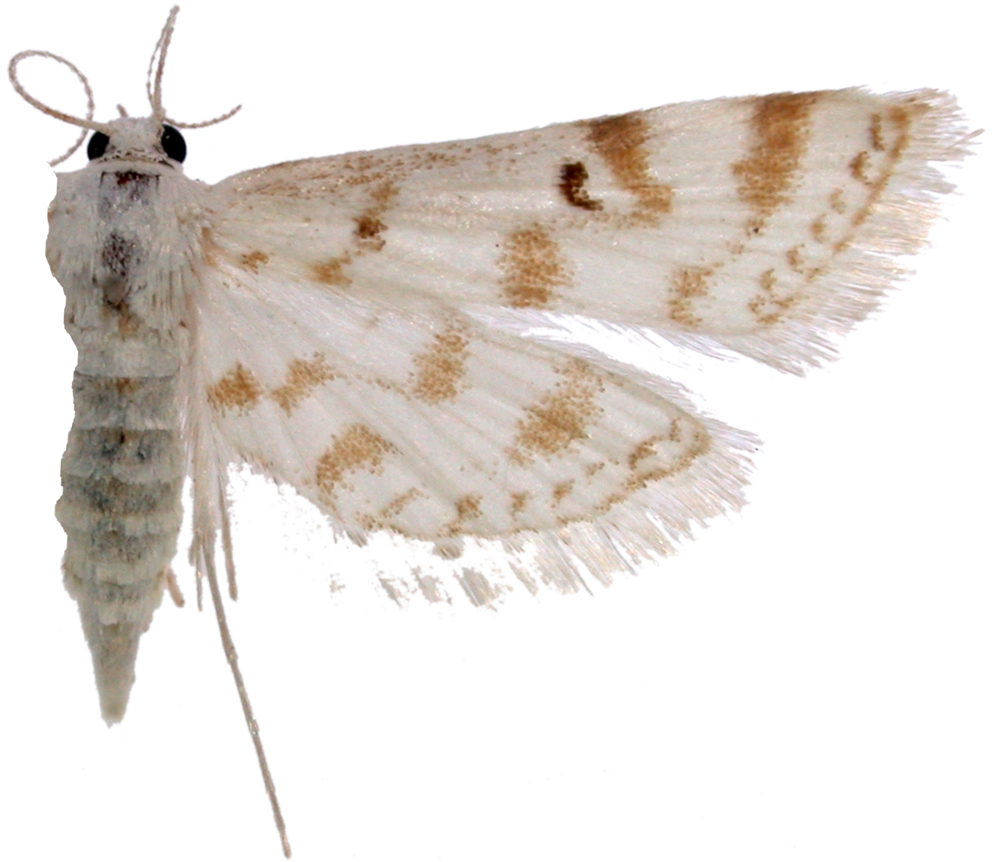
Parapoynx stagnalis Zeller
- Family: Crambidae
- Subfamily: Acentropinae
- Genus: Parapoynx
- Distribution: Neotropics [Introduced]. Widespread in Old World tropics and subtropics; Africa (S), Sri Lanka, India, Burma, Thailand, W.Malaysia, Singapore, Sabah, Sarawak, Sumatra, Java, Bali, Sulawesi, Philippines, Australia (Q, Vic).
- Habitat: Rice padi, lowland and hill ponds & lakes; <1200m.
- Wing Length: 8mm
Taxonomy
The holotype of Nymphula stagnalis Zeller, 1852: 26-27, is from South Africa (Natal) The male holotype is in the SBMNH.
- syn. Hydrocampa depunctalis Guenée, 1854: 274 As syn. in Shaffer et al. (1996);
- syn. Zebronia decussalis Walker, 1859: 481 TL Ceylon [Sri Lanka]. As syn. in Shaffer et al. (1996);
- syn. Cataclysta vestigialis Snellen, [1880]: 76 TL Java. The type is Leiden. As syn. in Shaffer et al. (1996);
- syn. Hydrocampa hillii Tepper, 1890: 49 [Type, not traced], was from Australia (NW Vic.) As syn. in Shaffer et al., (1996).
Description
The adult moths have white semi-transparent wings, They are traversed by pale brown submedian, median and postmedian zig-zag lines and a submarginal line of spots which give the species a patchy brown-spotted appearance. Each FW has two dark brown black comma-shaped marks. The male antennae are finely pubescent and are slightly swollen in comparison with the females, with sparse, well separated part-whorls of scales at the base of each flagellomere. The male fenulum links to a normal male type retinaculum. Often confused with the non-pest P. fluctuosalis (Sheppard et al., 1995: 7) but that has a distinctly striped horizontal pattern and the ocelli are close to the eye margin (RTS: 165).
Life History
The ‘padi [or rice] case worm’ is a leaf feeder on Oryza sativa (rice) (Poaceae) and causes severe loss of yield.
The rice caseworm is commonly found in rice fields in low populations constructing its case, cut from the leaf tips. It can build up and cause patches of severe defoliation that results in stunted growth and death of plants because of pesticide use, control practices, and ecological disruptions by weather.The rice plants can recover from the damage if there are no other defoliators present. However, maturity may be delayed for 7−10 days. For details of damage to food plants and life cycle see Sheppard et al., (1995: 4-10), also Conway & Tay (1968) and Bainbrigge-Fletcher (1914: 13, 430-432, Pl. XXXII).
References
- Zeller, P. C., (1852) Lepidoptera Microptera, quae J. A. Wahlberg in Caffrorum terrae collegit. 120 pp. Stockholm.
- Guenée, A., (1854) in Boisduval, J. B. A. D. & Guenée, A., 1854. Histoire Naturelle des Insectes. Species Général des Lépidoptères. 8 (Deltoides et Pyralites): 448 + 6 pp., 10 pl. Paris.
- Snellen, P. C. T., ([1880] 1880-1892) Lepidoptera. In Veth, P. J., (1880-1892). Midden-Sumatra. 4 (8). 92 pp., 5 pl. Leiden.
- Tepper, J.G.O. (1890) Common native Insects of South Australia, Part 2, Lepidoptera: 49 pp.
- Bainbrigge-Fletcher, T. (1914) Some south Indian insects and other animals of importance considered especially from an economic point of view. Printed by the Superintendent, Government Press, Madras: 564pp.
- Conway, G. & Tay, E.B. (1968) Crop pests in Sabah, Malaysia and their control: With a provisional check list of insects and other animals of agricultural importance in Sabah. Kementerian Pertanian dan Perikanan Sabah, Malaysia. [State Ministry of Agriculture and Fisheries (Sabah, Malaysia)]
- [RTS] Robinson, G.S., Tuck, K.R. & Shaffer, M. (1994) A Field Guide to the Smaller Moths of South-East Asia, Malaysian Nature Society Kuala Lumpur & Natural History Museum, London, 311 pp. 51 text figs, 32 pls.
- RTS (1994): 165, pl.28, fig.8.
- Sheppard, B.M., Barrion, A.T., Litsinger, J.A. (1995) Rice feeding insects of tropical Asia, International Rice Research Institute (IRRI), Philippines, Manila.
- Shaffer, M., & Nielsen, E.S. & Horak, M., (1996) Pyraloidea (In Nielsen, E.S., Edwards, E.D. & Rangji (Eds.) Checklist of the Lepidoptera of Australia: 164 - 199, CSIRO, Australia.
- Walker, F. (1859c) Pyralides. In; List Spec. Lepid. Ins. Coll. B. M., Cat. Lepid. Heterocera. Ser. 4, 17: 255-508.
- Speidel, W. & Mey, W. (1999b) Catalogue of the oriental Acentropinae (Crambidae, Pyralidae). Tijdschr. v. Entomol. 142: 125-142, figs. 1-3.