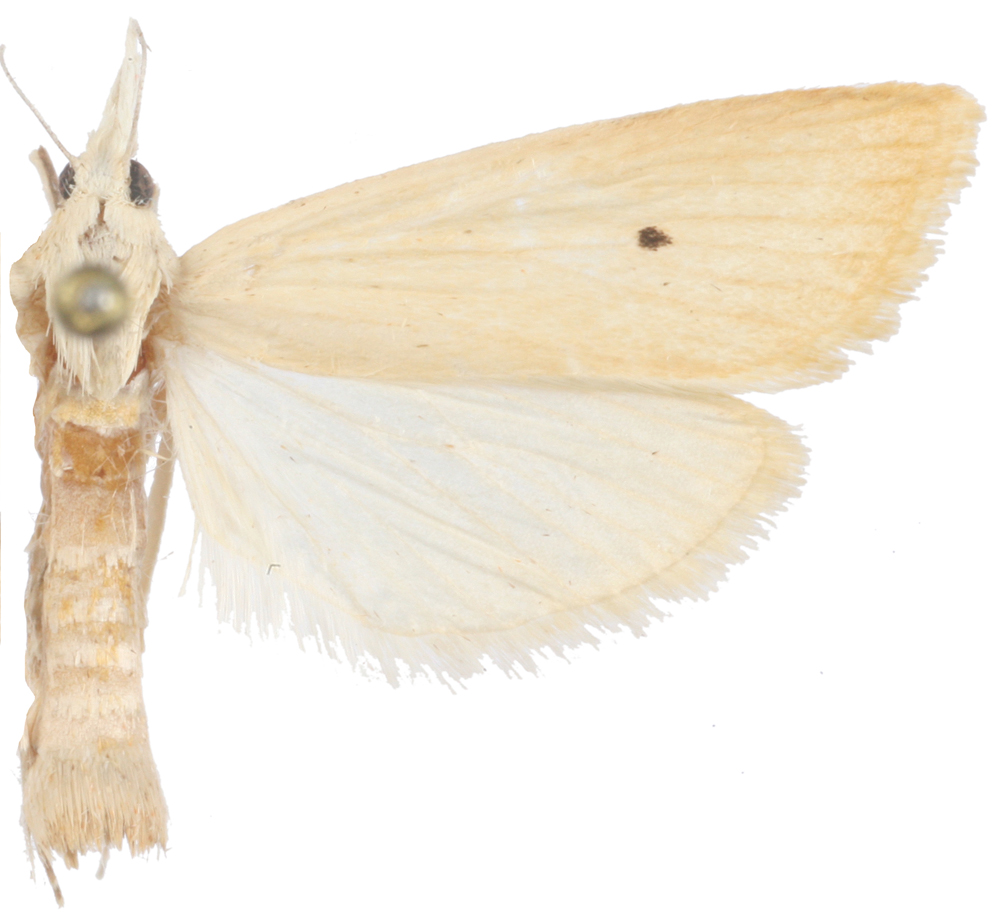
Scirpophaga incertulas Walker
- Family: Crambidae
- Subfamily: Schoenobiinae
- Genus: Scirpophaga
- Distribution: Afghanistan, Sri Lanka, India (W. Bengal), Nepal, Bangladesh, Burma, Thailand, Vietnam, W. Malaysia, Singapore, Sumatra, Sabah, Brunei, Labuan, Sarawak, Kalimantan Berat, Lombok, Tambora, Java, Bali, Sulawesi, Philippines, China (Hong Kong), Taiwan, Japan. Lowland to submontane; mainly cultivated areas (padi fields) but also, oil palm plantations, primary forest and forest edges.
- Habitat: <1500m
- Wing Length: Female 23-33; male 22-24.mm
Taxonomy
The male holotype of Chilo incertulas Walker, 1863a: 143 is from Sarawak. comb. n. to Scirpophaga Treitschke, 1832 (Lewvanich, 1981: 243).
Description
This species has marked sexual dimorphism. The females have a pale yellowish FW with a distinct black spot in the cell. The apical area may be slightly more fulvous. Labial palpus pale yellowish ochreous. The anal tuft is a dingy yellow-grey. The Male FW is ochreous with a darker dashed line running inwards from the wing apex with one dark fuscous spot at the lower angle of the cell (markings as in S. nivella). HW white with yellowish ochreous suffusion in costal half; frenulum double-bristled. UnS fuscous Anal tuft pale ochreous white.
Life History
The Yellow Stem borer is a polyvoltine, monophagous, pest on Rice, (Oryza sativa) found in most oriental rice growing areas. It will also feed on wild rice. The c.150 eggs are laid in masses of 50-80 near to the leaf blade tip and covered with hairs from the female anal tuft. The young larvae bore into the leaf sheath entering the basal part of a young rice plant about 5-10cm above water. If the crop is at the heading stage they bore into the internode causing ‘whiteheads’ and cause the maximum crop damage. Being negatively geotropic larvae crawl upward towards the top of the plant where they stay only for short periods. They showed tendency to disperse. Some suspend themselves from a silken thread and swing with the wind to reach the adjacent plants. From the second stage onwards the larvae construct a case out of the leaf blade which can fall into the water allowing the larvae to ‘swim’ to other plants. They may diapause if temperatures fall below 28oC. They pupate in whitish silken cocoons in the stem, straw or stubble after 4-7 larval stages (van der Goot 1925; Pathak & Khan 1994).
References
- Hampson, G. F., (1895b) Proc. Zool Soc. London 1895: 5, On the classification of the Schoenobiinae and Crambinae, two subfamilies of moths of the family Pyralidae: 897-974.
- Chen, Y. H. & Romena, A. (2006 Aug) Feeding Patterns of Scirpophaga incertulas (Lepidoptera: Crambidae) on Wild and Cultivated Rice during the Booting Stage) Environmental Entomology, 35 (4):1094-1102.