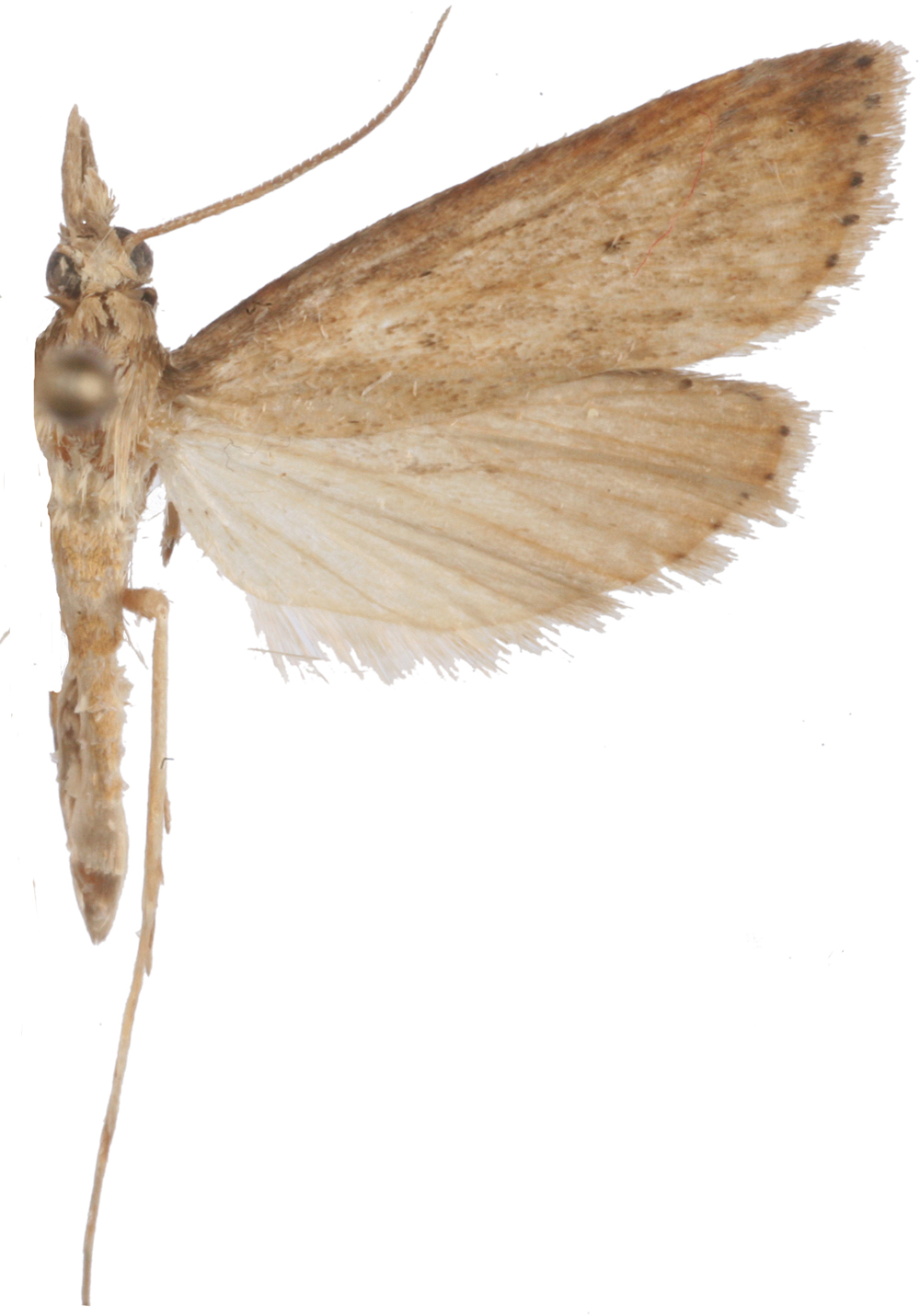
Scirpophaga nivella Fabricius
- Family: Crambidae
- Subfamily: Schoenobiinae
- Genus: Scirpophaga
- Distribution: Sri Lanka, India (Assam, Bihar, Karnataka, Kerala, West Bengal, Andaman Is.), Bangladesh, Nepal, Burma, Thailand, W. Malaysia, Singapore, Sabah, Brunei, Sarawak, Labuan, Kalimantan Timur, Sumatra, Java, Sumba, Sulawesi, Irian Jaya, PNG, Timor, Tonga, Australia (W, NT, Q), Philippines, China (mainland, Hong Kong), Taiwan, Japan.
- Habitat: Lowland & hill padi fields <1100m.
- Wing Length: Male 13; female 14mm
Taxonomy
The female holotype of Tinea nivella Fabricius, 1794: 296 TL [India?] Ind. Or., is in the Z.M. Copenhagen.
Description
Marked sexual dimorphism with females slightly larger than males. Female wingspan ranges 27.5-47mm and male 22-34mm. In the male the markings on the FW can be variable. The three spots on the submedian fold are sometimes obsolescent but the fourth spot at the lower angle of the cell is usually prominent. In a few specimens, the markings are entirely absent, and the wing is plain ochreous. In the female the FW is usually shining white, but it is sometimes suffused with pale ochreous. The broad anal scale tuft is yellowish with some grey. In the male the antenna is ciliated ventrally but the cilia are evenly distributed not fasciculate as in Donacaula Meyrick, 1890. The female frenulum is a double bristle Lewvanich (1981) gives illustrations of the genitalia (male figs 33, 34; female figs 97, 98) but reported some variability over the range. The males of this sp. have the colour and markings of the forewing very similar to those of the males of S. incertulas, which is a also very serious pest of rice. There is no doubt that males of S. nivella were misidentified as S. incertulas in many of the numerous publications citing the latter.
Life History
S. nivella, which was mainly recorded as S. chrysorrhoa, is a serious pest, a stem borer, of Rice (Oryza sativa) (Poaceae), Scirpus spp., Cyperus spp., Cladium articulatum and Eleocharis spp. (Cyperaceae). The eggs are laid in masses of 6-30 usually on the underside of leaves near the main vein and are covered by scales from the anal scale tuft. The larvae of the borers enter the tiller, feed, grow and cause the characteristic symptoms of ‘dead hearts’ or ‘white ears’ depending on the crop stage. At tillering stage, the feeding frequently results in severing the apical parts of the plant from the base. The young larvae are brownish yellow and become whiter in colour as they age. Dorsally a red blood vessel line is seen medially and the brown cervical sclerite has a white median line. The pupa is yellow in a silk cocoon and pupates near the epidermis.
References
- Lewvanich, A. (1981) A revision of the old world species of Scirpophaga (Lepidoptera: Pyralidae). Bull. Br. Mus. (Nat. Hist.) Entomol. 42 (4): 185-298.
- Caradja, A. (1925a). Ueber Chinas Pyraliden, Tortriciden, Tineiden nebst kurze Betrachtungen, zu denen das Studium dieser Fauna Veranlassung gibt. Acad. Romana Mem. Sect. Stiint. ser. iii, 3 (7): 1-127, 2 pls.