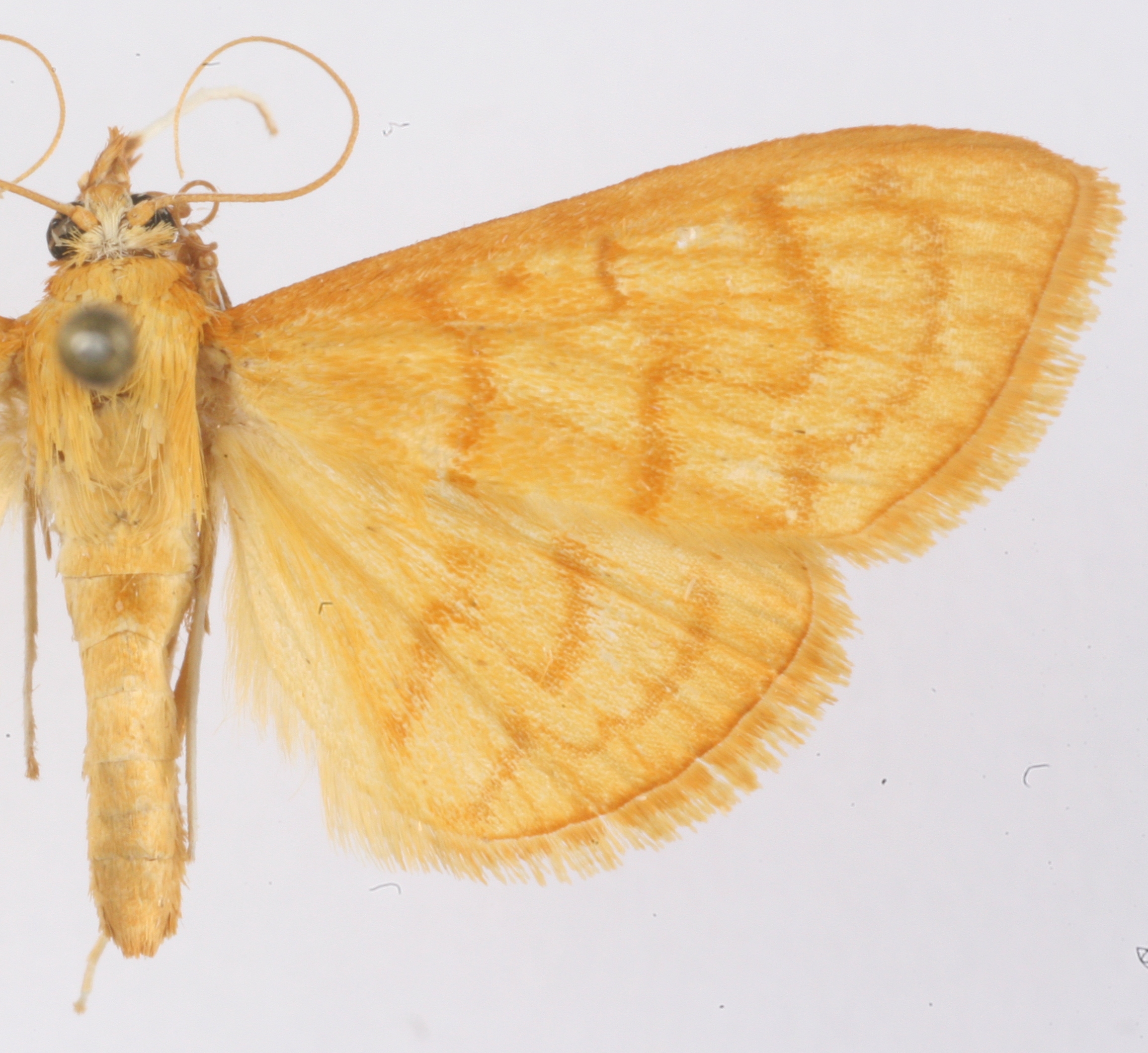
Spinosuncus aureolalis Lederer
- Family: Crambidae
- Subfamily: Pyraustinae
- Genus: Spinosuncus
- Distribution: Madagascar?, Sri Lanka, India (East?, Himalayas, Meghalaya?, Nepal, Burma, Sabah, Sarawak, Andaman Is., Australia (Q), Tahiti. China (Yunnan, Guangxi, Hong Kong?).
- Habitat: Lowland primary forest & disturbed areas <600m.
- Wing Length: 14mm
Taxonomy
The lectotype of Botys aureolalis Lederer, 1863d: 375, 473, TL Sikkim Is in the BMNH Moore Coll. 94-106, BMNH Slide No. 8678, designated by Banziger (1995). comb. n. to Spinosuncus (Figs 8, 15-16, 24-25, 28)
- syn. Pyralis ochrealis Moore, 1877: 614. TL Andaman Is. (Port Blair). As a junior subjective syn. (confirmed Chen et al. 2018)
- syn. Microstega aureolalis (Lederer): Bänziger, 1995: 270 (Subs Mispell. 270.
Other possible Syns in Swinhoe 1901?
- Syn? Pionea acutangulata Swinhoe 1901: 26. TL Meghalaya (Jaintia Hills). As a junior subjective syn (LepIndex);
- syn? Paliga contractalis Warren, 1896: 113. TL East India.
- syn? Botys holoxanthalis Mabille 1881: 62. TL Madagascar. As a junior subjective syn. (LepIndex).
Description
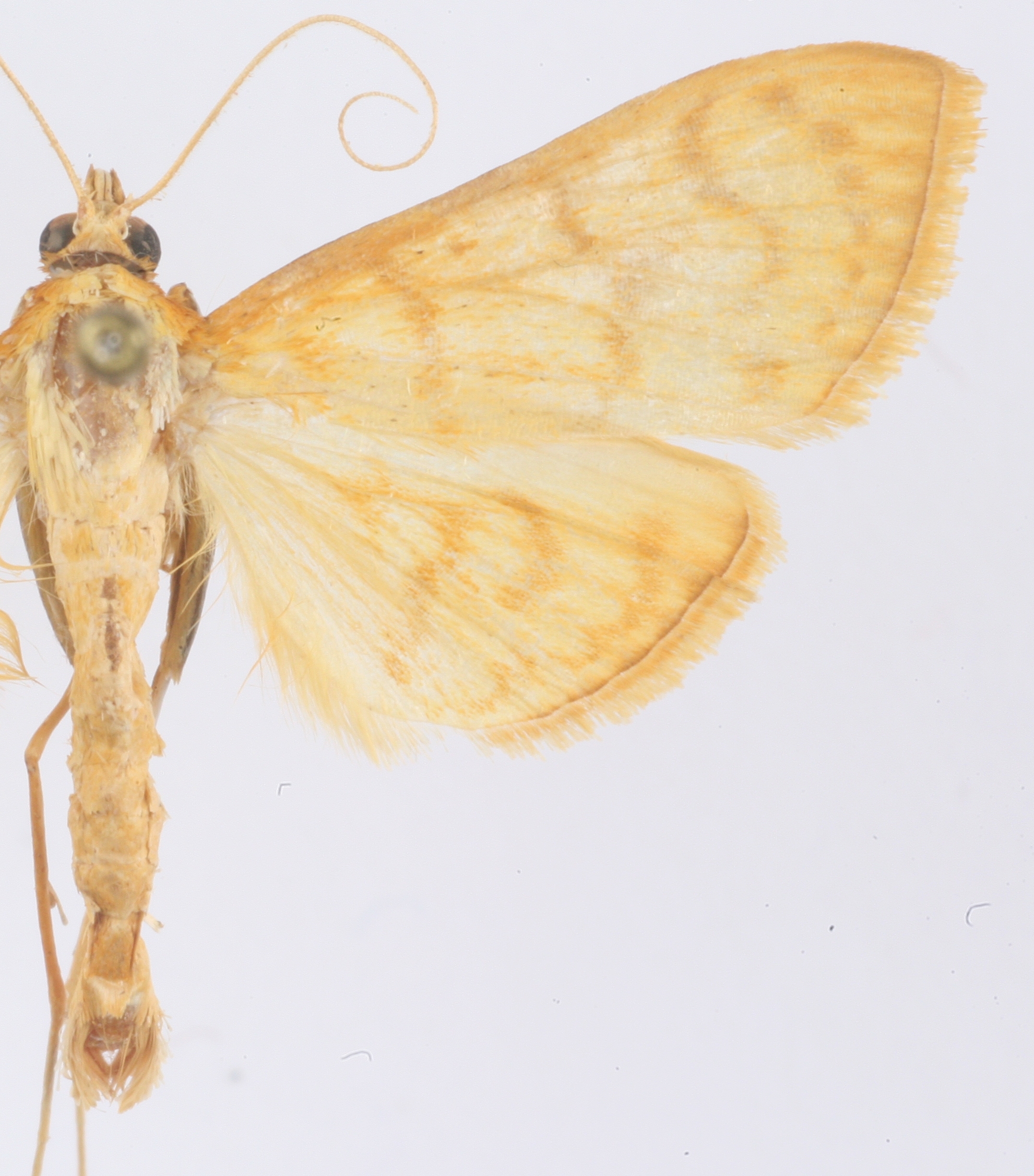
A pale yellow sp. with darker yellow lineation. The broken lineation of this orange species is almost identical to many Pseudopagyda spp. 1. Note the modified middle pair of legs which have what seem to be penknife type hair-scale sheaths similar to those seen on Pseudopagyda ingentalis Re-described by Chen, Zhang & Li (2018). Their diagnosis: Spinosuncus aureolalis has a large wingspan (<26 mm). The ground colour of the wings is the darkest within the genus. Though S. aureolalis has a similar wingspan as S. praepandalis, it can be distinguished by the sinuate but not thickened anterior part of the postmedial line of the forewing near costa and the smooth, not dentate wing lines. In the male genitalia, it is characterised by the uncus distally with two large spines, the cheliform sacculus projections, and the fin and needle-shaped setae forming editum on the sella distally (as in S. quadracutus). In the female genitalia, the two large, hook-like notches anterolaterally on the sinus vaginalis and the laterally broad, granulated antrum (as in S. q uadracutus) are diagnostic. The appearance of S. aureolalis is most similar to that of S. quadracutus, both having the same wing pattern. The differences between these two species are given in the diagnosis of S. quadracutus. Genitalic determination is needed to confim identity. Schulze (2000) taxon #175 a series of specimens determined as Phlyctaenia c.f. aureolalis Lederer by W. Speidel.
References
- Slamka, F. (2013) Pyraloidea of Europe, Pyraustinae & Spilomelinae, Bratislava: 357pp.
- Chen, K. D., Zhang, D. & Li, H. H. (2018): Systematics of the new genus Spinosuncus Chen, Zhang & Li with descriptions of four new species (Lepidoptera, Crambidae, Pyraustinae). ZooKeys 799: 115-151.
- Lederer, J. (1863d [Dec]) Beitrag zur Kenntniss der Pyralidinen. Wien. entomol. Monat. 7 (12): 427-502, pl. 2-18.