![Thumbnail for Conogethes punctiferalis [partim.] Guenée](https://cdn.pyralidsofborneo.com/punctiferalis.jpg)
Conogethes punctiferalis [partim.] Guenée
- Family: Crambidae
- Subfamily: Spilomelinae
- Genus: Conogethes
- Distribution: Pakistan, Sri Lanka, India (Maharashtra, Karnataka, Central, Assam, Sikkim, Meghalaya), Bhutan, Nepal, Burma (Ava), W. Malaysia, Singapore, Sabah, Brunei, Indonesia [East Indies], Batchian, Mysol, Seram, Ava), Philippines, China (N), Taiwan, Korea, Japan.
- Habitat: New Guinea, Australia (Q, NSW); Lowland mainly cultivated areas, disturbed forest but absent from primary forest in Sabah.
- Wing Length: 12mm
Taxonomy
The holotype of Astura punctiferalis Guenée, 1854: 320 is from India. Comb. rev. to Conogethes (Shaffer et al., 1996).
- syn. Deiopeia detracta Walker, 1859a: 186, originally described in the Arctidae and transferred to the Pyraustinae [Dichocrocis]. Syn. n. (Shaffer et al., 1996). TL Singapore. The co-type is in the BMNH;
- syn. Astura guttatalis Walker, 1865 [1866]:1381. It is type #1055 in the Oxford U.M.N.H. collected by A.R. Wallace from Ceram. Syn. n. (Shaffer et al., 1996).
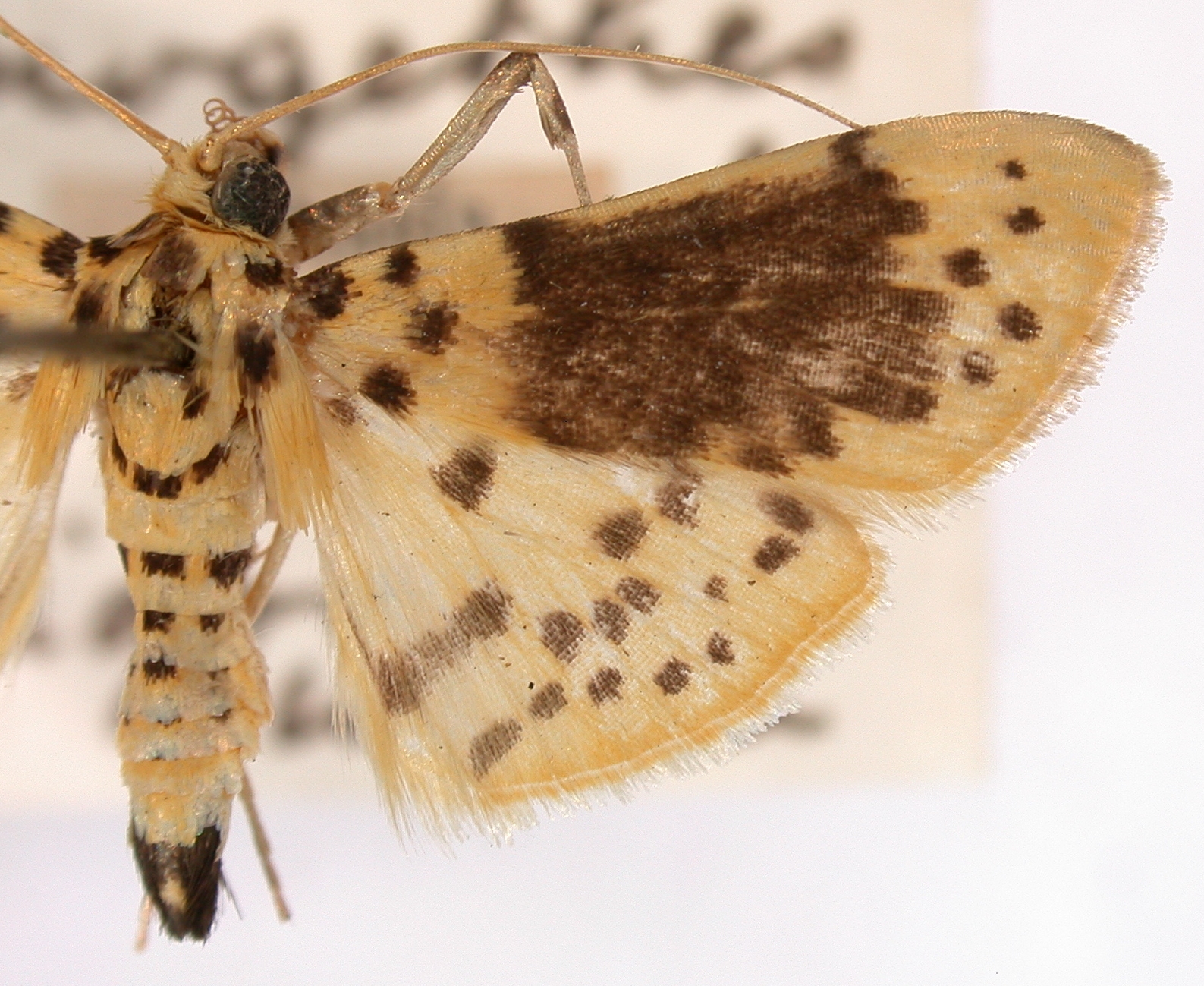
- syn. Botys nicippealis Walker, 1859e: 999; TL Ceram. Syn. n. (Shaffer et al., 1996). This is probably incorrect the type looks nothing like the holotype of C. punctiferalis. The holotype of Botys nicippealis Walker, 1859e: 999 from Ceram is in the BMNH. It is placed as a junior subjective syn. of Conogethes punctiferalis (Guenée, 1854) but until these C. punctiferalis group spp. are re-examined we treat it as a good sp. in the C. punctiferalis group needing investigation as suggested by Inoue & Yamanaka, (2006: 86 and Shashank (2018).
- Nec syn. Astura semifascialis Walker [1866] 1865: 1381. TL Australia (Moreton Bay). This was considered a black suffused variety of C. punctiferalis (Guenée, 1854) by Guenée (var A). TL Khasis, or var nigralis Warren 1896: 168. TL Khasis (type in the BMNH). Shaffer et al. (1996) consider C. semifascialis as a good sp. in its own right with C. nigralis and C. jubata (Lucas, 1900: 152). TL Australia, Brisbane) as junior subjective syns.
The Conogethes group spp. complex and C. punctiferalis Guenée [partim.] can only be accurately determined by DNA sequence and genitalic inspection. Shashank et al. (2018) revealed by phylogenetic analysis that C. punctiferalis and C. semifascialis are both polyphyletic, each represented by two clades. The C. punctiferalis clade comprises only specimens from the Oriental and East Palaearctic (Japan) regions as the true C. punctiferalis, since the genitalia match those figured in Inoue & Yamanaka (2006), whereas the clade comprising specimens from the Austral-Asian region (Australia, New Guinea) as C. cf. punctiferalis and consider it a separate sp. Unfortunately no material of C. cf. punctiferalis was available for their morphological study.
Description
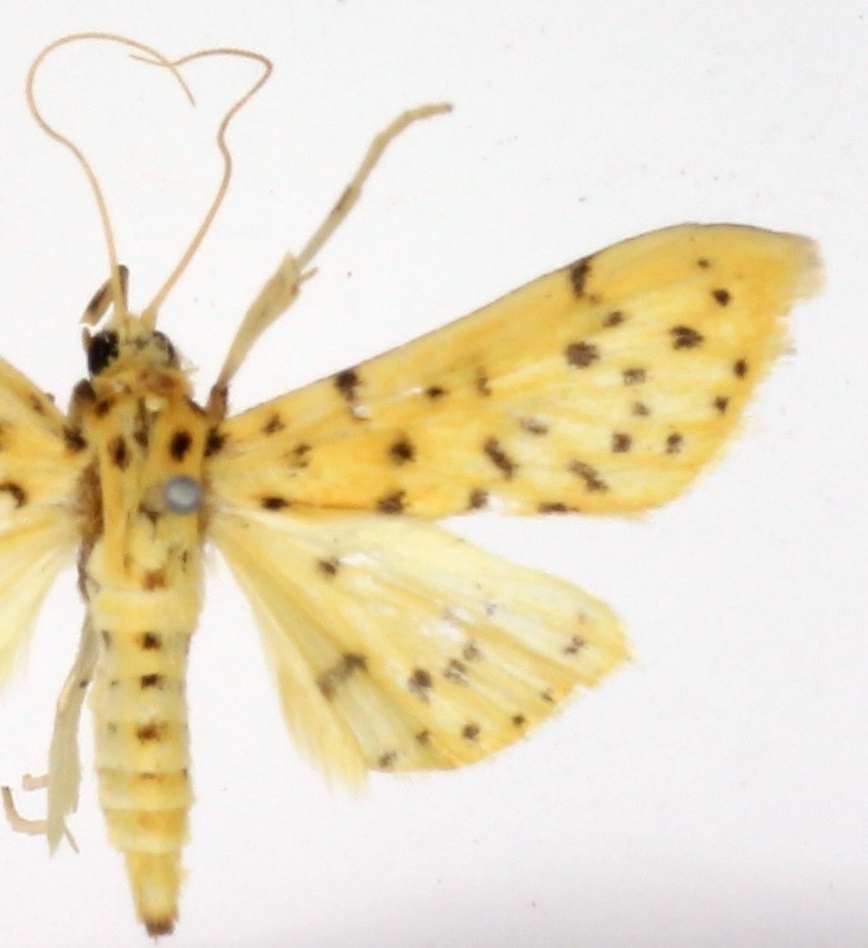
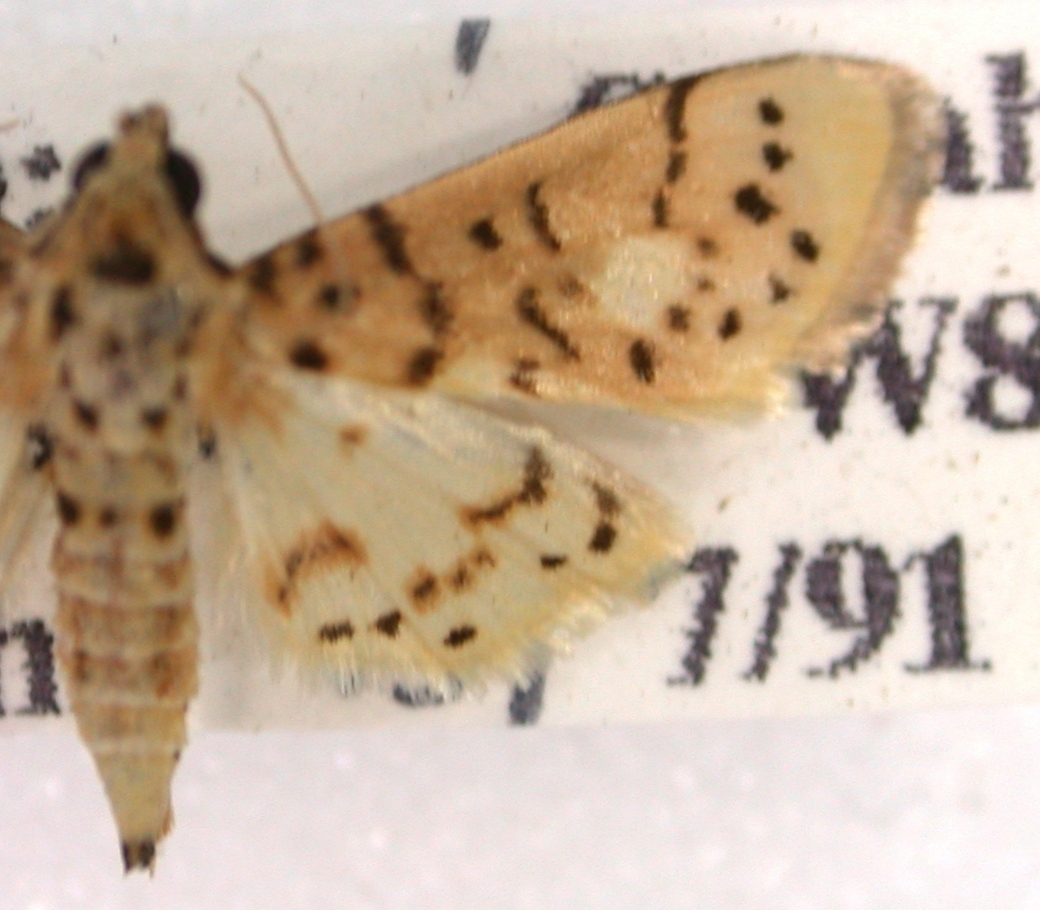
This common moth with intensely yellow wings and small black spots is the most densely spotted Conogethes sp. and the aggregate is distinctive. The spotting is usually very discrete but in some specimens the spots are enlarged or partly joined as lines and although the FW and HW are a similar and also bright yellow they may be a paler yellow in some specimens. Note the spots join to form a diagonal line near the HW anal angle. The thorax and abdomen are also bright yellow with black spots. The abdominal tip of the males is black scaled.
Life History
The yellow peach moth complex is a serious multivoltine, polyphagous, pest of a very wide range of cultivated plants, from an unusually wide range of families. The eggs are glued to the surface and the newly hatched larvae bore into the fruit or sometimes a shoot. It has five larval instars but deveopment time depends on the foodplant. Food plants include; Turmeric Curcuma longa, Ginger Zingiber officinale (Zingiberaceae), Rambutan Nephelium lappaceum, Lychee Litchi chinensis (Sapindaceae), Sapodilla Manilkara zapota (Sapotaceae), Mulberry Morus nigra (Moraceae), Pawpaw [Papaya] Asimina triloba, Custard Apple Annona reticulata (Annonacea), Livingstonia Palm Livistonia humilis, Coconut Cocos nucifera (Arecaceae), Sunflowers Helianthus annuus (Asteraceae), Durian Durio zibethinus (Bombacaceae), Castor Oil Plant Ricinus communis (Euphorbiaceae), Billy Goat Plum Planchonia careya (Lecythidaceae), Sorghum Sorghum bicolor, Maize Zea Mais (Poaceae), Macadamia Nuts Macadamia integrifolia (Proteaceae), Peach Prunus persica (Rosaceae), various Citrus e.g. Lemon, Orange, (Rutaceae), Eggplant Solanum melongena (Solanaceae), Flame tree Brachychiton acerifolium (Sterculiaceae), Cardamom Elettaria cardamomum (Zingiberaceae), Flame tree Brachychiton acerifolius (Sterculiaceae). Cotton Gossypium hirsutum, Cocoa, Theobroma cacao (Malvaceae), Mango Manganifera indica (Anacardiaceae), Pomegranate Punica granatum (Lythraceae), Pea Pisum sativum (Fabaceae). Chakravarthy et al. (2013)investigated the pest biology and development on Ricinus communis. Several workers have identified the pheromones involved in mating (Kimura & Honda, 1999) and males of this sp. were found to communicate with females by emitting loud ultrasound (103 dB peak equivalent sound pressure level at 1 cm; dominant frequency 82 kHz) before attempting copulation (Nakano et al. 2012). Larval food plant choice is the start for unravelling the Conogethes group sp. complex (Shashank et al. 2018) and it is unwise to allocate a morphotype to C. punctiferalis Guenée [partim.] without DNA sequences and genitalic inspection.
References
- Guenée, A. (1854) Deltoïdes et pyralites. In Boisduval, J.A. & Guenée, A., Hist. nat. des Insectes (Spec. gén. Lépid.) Vol. 8, 448pp. + 10 pls., Librarie Encyclopédique de Roret: Paris.
- Walker, F. (1865 [1866 Jan 13]) List Spec Lepid. Ins. Coll. B. M., Cat. Lepid. Heterocera. 34, (Suppl. 4): 1121-1533.
- Shaffer, M., & Nielsen, E.S. & Horak, M. (1996) Pyraloidea (In Nielsen, E.S., Edwards, E.D. & Rangji (Eds.), Checklist of the Lepidoptera of Australia; 164-199, CSIRO, Australia.
- Kimura, T, & Honda, H. (1999) Identification and possible functions of the hairpencil scent of the yellow peach moth, Conogethes punctiferalis (Guenée) (Lepidoptera: Pyralidae). Appl. Entomol. Zool., 34: 147-153.
- Inoue, H. & Yamanaka, H. (2006) Redescription of Conogethes punctiferalis (Guenée) and description of two new closely allied species from Eastern Palaearctic and Oriental regions (Pyralidae: Pyraustinae). Tinea, 19 (2), 80-91.
- Nakano, R., Takanashi, T., Ihara, F., Mishiro, K., Toyama, M., Ishikawa, Y (2012) Ultrasonic courtship song of the yellow peach moth, Conogethes punctiferalis (Lepidoptera: Crambidae). Appl. Entomol. Zool., 47: 87-93.
- Chakravarthy, G.A.K., Naik, M.I., Basavaraj, K. & Naik, C.M. (2013) Biology of castor shoot and capsule borer, Conogethes punctiferalis Guenée (Lepidoptera: Pyralidae). Current Biotica, 7 (3): 188-195. ISSN 0973-4031
- Shashank, P.R., Kammar, V., Mally, R. & Chakravarthy, A.K. (2018) A new Indian species of shoot and capsule borer of the genus Conogethes (Lepidoptera: Crambidae), feeding on cardamom. Zootaxa 4374 (2): 215-234.
- Walker, F. (1859a) Catalogue of the heterocerous Lepidoptera collected at Singapore by Mr. A.R. Wallace with descriptions of new species. J. Proc. Linn. Soc. 3: 183-198.
- Walker, F. (1859e) Pyralides, In; List Spec. Lepid. Ins. Coll. B. M., Cat. Lepid. Heterocera. Ser. 4, 19: 799-1036.