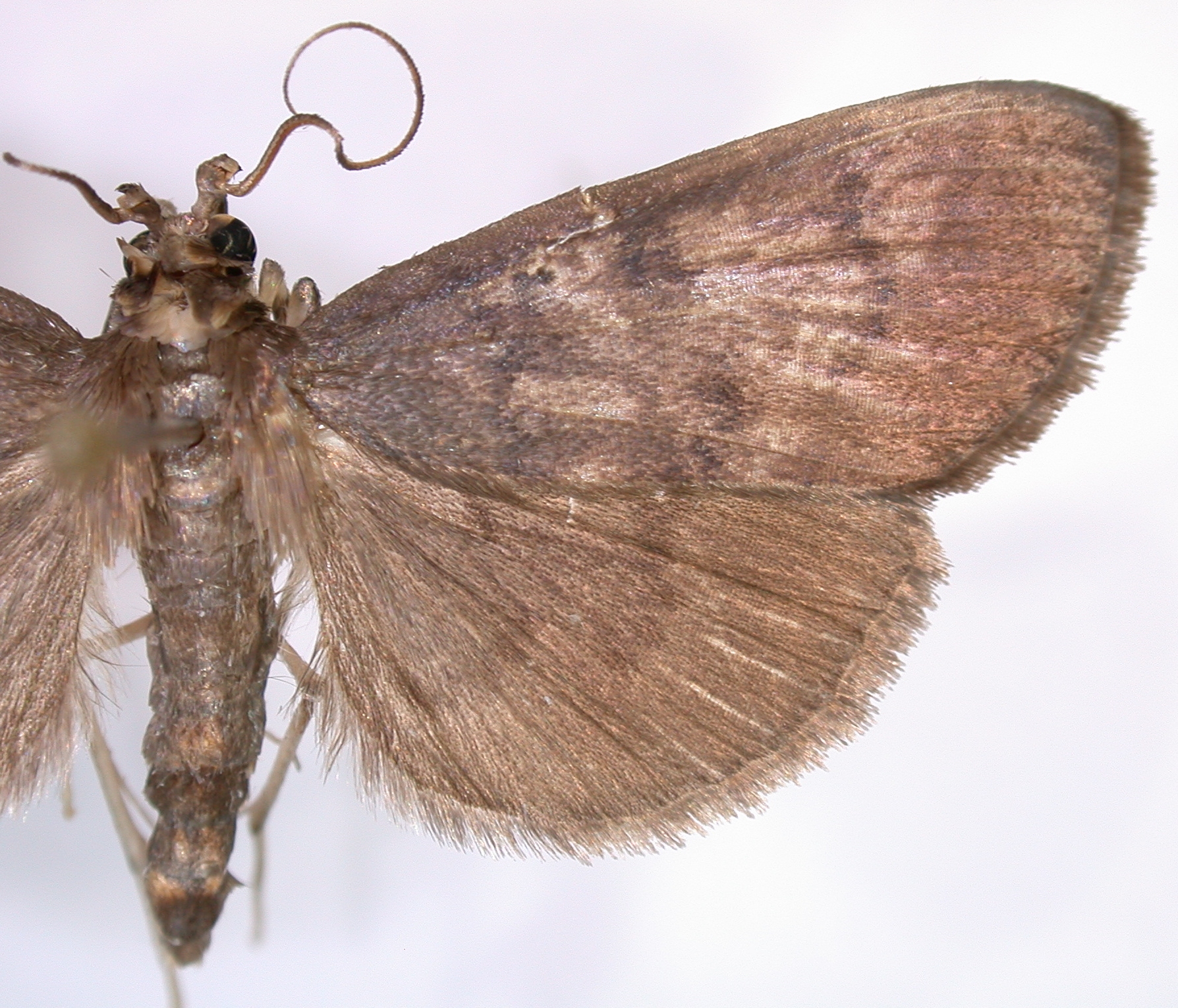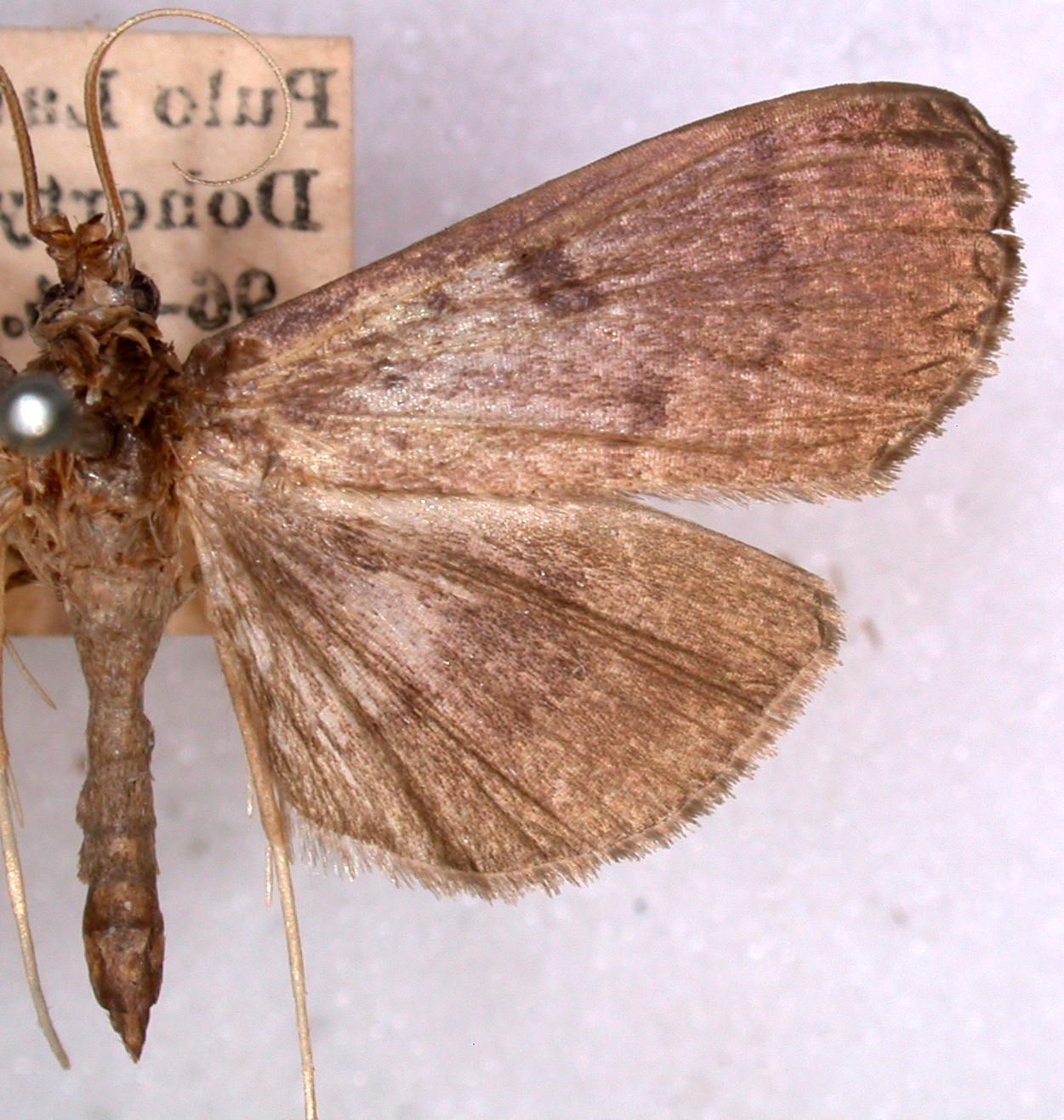
Coptobasis crotonalis Walker
- Family: Crambidae
- Subfamily: Spilomelinae
- Genus: Coptobasis
- Distribution: Sri Lanka, India (Sikkim, Andaman Is.), Singapore, Sabah, Kalimantan Selatan, Louisiade Arch. (St. Aignan), Fiji?, Taiwan.
- Habitat: Lowland primary & disturbed forest, and cultivated areas <650m.
- Wing Length: 13-16mm
Taxonomy
The holotype of Botys crotonalis Walker, 1859e: 997 is from Sri Lanka. comb. n. to Pramadea (Kirti & Gill, 2004).
- syn. Hedylepta pilocrocialis Strand, 1918: 44-46. TL Taiwan, (Kaoshung Co. Kosempo). Syn. n. (Shibuya 1928: 29). It is the TS of subgenus Subhedylepta Strand 1918: 44-46. As syn. in (Wang & Speidel, 2000: 165);
- syn. Hedylepta pilocrocualis (LepIndex). Misspell.
Hampson considered Notarcha halurga Meyrick 1886: 259; TL Fiji as a junior subjective syn. of C. cohaesalis Walker 1865 [1866]: 1418 (Hampson, in Tams, 1924: 286).
Tams writes 'Sir George Hampson has sunk [Notarcha] halurga Meyr. to [Coptobasis] cohaesalis Walk., but Meyrick's species has the whole of the pectus silvery-white, the leg; yellowish-white, and very little trace of the purplish reflections, and more nearly resembles crotonalis Walk., so much so that two specimens obviously nearer to halurga Meyrick than to the type of crotonalis have been placed in the crotonalis series.'
Consulting Meyrick's original description of N. halurga the Meyrick type referred to above was probably mis-identified by Hampson. Meyrick (1886: 259) describes halurga as a brown sp. with purple reflections with few wing markings but they including a dentate post median line and a pale centred lunule. He also describes the antennal base modification. This description very closely resembles C. crotonalis. On these grounds we provisionally consider C. halurga as a junior subjective syn. of Sylepta crotonalis. We agree with Tams that no definite conclusions can be reached, however, until the types of cohaesalis Walker and halurga Meyrick can be re-examined.
Kirti & Gill (2004) removed Pramadea [TS P. denticulata Moore (1888) 211-212] from syn. with Syllepte and published illustrations of male and female genitalia of all the 4 Indian spp.; P. denticulata (Moore), P. ovialis (Walker), P. lunalis (Guenee) and P. crotonalis (Walker) and gave a key to the spp. of the genus.
In Globiz as Pramadea, which is technically correct, but here we provisionally treat it in Coptobasis Lederer 1863 as it is superficially similar to some of the C. mesospectralis group spp..
Description
A silky, dark brown sp. FW with a brown reniform stigma and an indistinct darker brown post-median line which is coarsely pectinate. The HW has indistinct darker patches following the median fascia. The head body and the long abdomen are dark brown underside paler. Underneath it has a buff pectoral collar. The antennal bases are highly modified. The pedicel has two short pointed lateral projections either side of the offset scape base. The simple flagellum is finely ciliate tapering to the tip. The antennal pedicel of Botys sulcialis Walker, 1859d: 684 are very similar but the wings of that sp. resemble Coptobasis mesospectralis. Phostria schediusalis Walker 1859d: 683-684 is similar but has a whitish UnS collar. Superficially similar to C. mesospectralis group spp. rather than to the Coptobasis Authaeretis group group of spp.. Schulze (2000) taxon #442. A good illustration of syntype Subhedylepta pilocrocualis [UpS & UnS] in Wang & Speidel (2000: 165).
Life History
Quick et al. (2012) described Colastomion wanang (a braconid) from four specimens which were solitary larval endoparasitoids of one or both of two similar sp. which are superficially similar to ‘Syllepte’ crotonalis Walker (CRAM078, Genbank GU695707 and CRAM092, Genbank GU695702).
References
- Moore, F. (1879-1888 [1888]) In: Hewitson & Moore Descr. new Ind. lepid. Colln. late Mr. W. S. Atkinson, 299 pp., 8 pls.
- Strand, E. (1918): in H. Sauter’s Formosa-Ausbeute: Pyralididae, Subfam. Pyraustinae., Dt. ent. Z., Iris, Dresden, 32, (1/2): 33-91.
- Tams, W.H.T. (1924) List of the moths collected in Siam by E.J. Godfrey, B.Sc., F.E.S., with descriptions of new species. J. nat. Hist. Soc. Siam, 6 (3): 229-289, pl. 17.
- Shibuya, J. (1928). The systematic study on the Formosan Pyralidae. Rep. Fac. Agric. Hokkaido Univ. 22 (1): 300 pp., pls. 1-9.
- Schulze, C.H. (2000) Auswirkungen anthropogener Störungen auf die Diversität von Herbivoren. (Analys von Nachtfalterzönosen entlang von Habitatgradienten in Ost-Malaysia). Unpubl. PhD Thesis, University of Bayreuth, Germany: 350 pp.
- Wang, HsiauYue. & Speidel, W (2000) Guide Book to Insects in Taiwan (19). Pyraloidea (Pyralidae, Crambidae). Shu Shin Books, Taipei, Taiwan: pp 295.
- Kirti, J. S. & N. S. Gill 2004: Revalidation and recharacterization of genus Pramadea Moore (Pyraustinae: Pyralidae: Lepidoptera). J. Ent. Res. New Delhi, 28 (3): 179-186.
- Quicke, D., Smith, M., Miller, S., Hrcek, J. & Butcher, B. (2012) Colastomion Baker (Braconidae, Rogadinae): nine new species from Papua New Guinea reared from Crambidae. J. Hymenoptera Res., 28: 85-121.
- Walker, F. (1859d [May 10]) Pyralides, In; List Spec. Lepid. Ins. Coll. B. M., Cat. Lepid. Heterocera. Ser. 4, 18: 509-798.
- Meyrick, E. (1886a) Descriptions of Lepidoptera from the South Pacific. Trans. ent. Soc. Lond.:189-296.
- Walker, F. (1859e) Pyralides, In; List Spec. Lepid. Ins. Coll. B. M., Cat. Lepid. Heterocera. Ser. 4, 19: 799-1036.
- Warren, W. (1896c) XVIII New species of moths from the Khasia Hills, Ann. Mag. Nat. Hist., Ser. 6, 18 (104): 163-177.