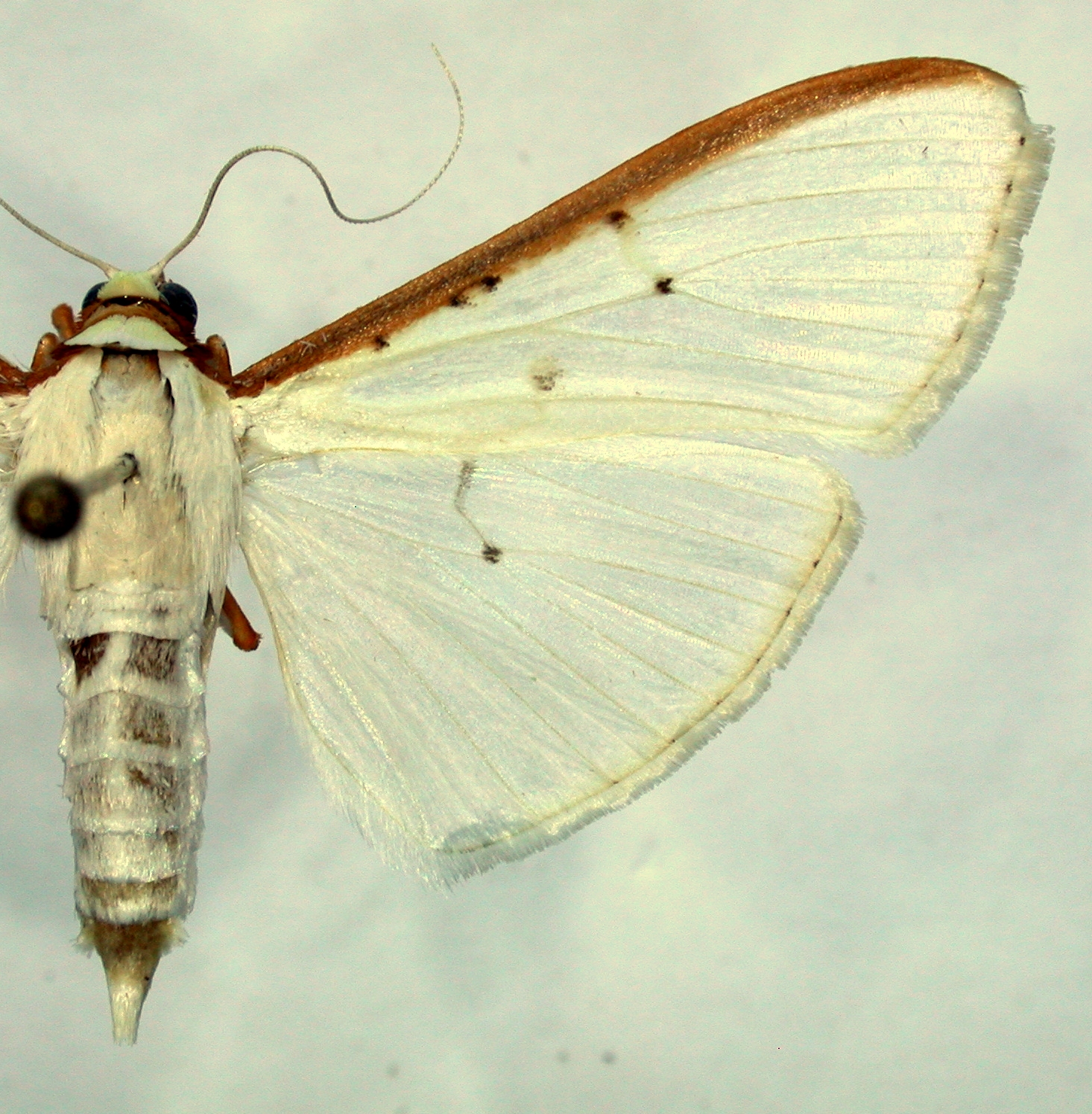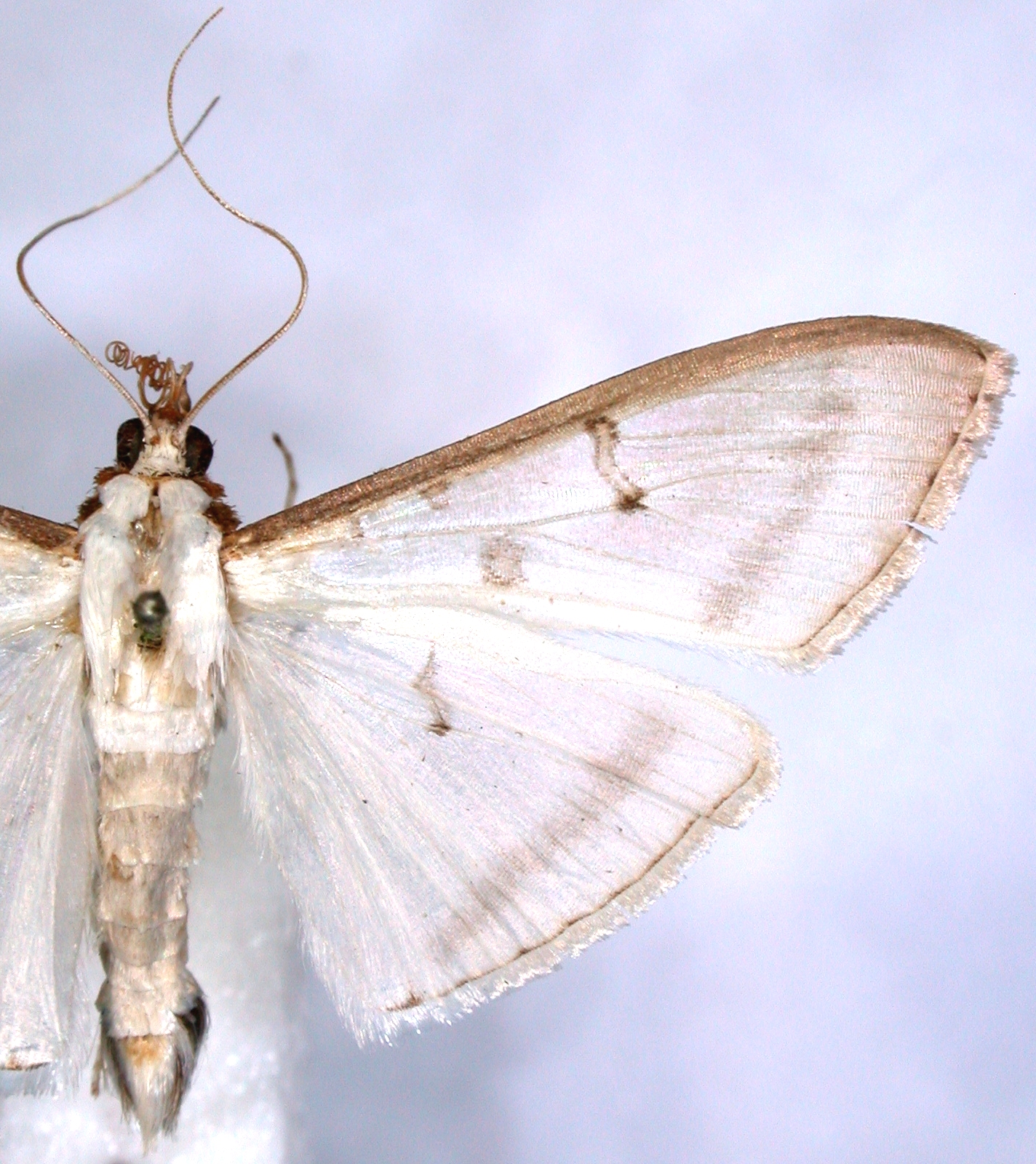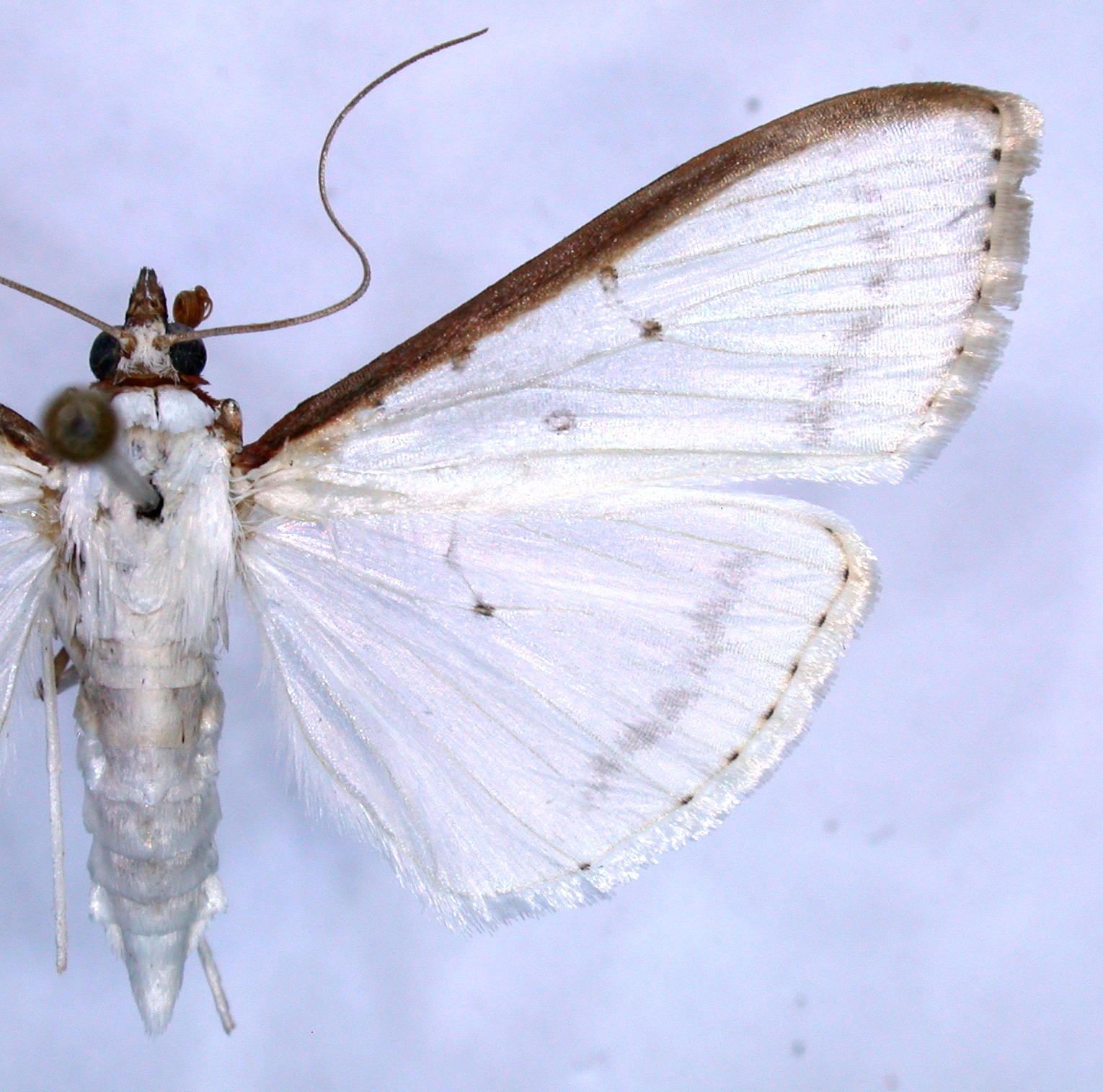
Cydalima warrenalis Swinhoe
- Family: Crambidae
- Subfamily: Spilomelinae
- Genus: Cydalima
- Distribution: No data.
- Habitat: Lowland to lower montane <1400m.
- Wing Length: 6.5mm
Taxonomy
The holotype of Margaronia warrenalis Swinhoe, 1894: 148 is from India (Meghalaya, Cherapunji). Munroe (1977) transferred to it to Palpita as a new combination and designated a lectotype.
However this is a complex including P. nigropunctalis Bremer 1864: 67, pl. 6 fig. 5, awaiting definitive DNA barcoding and the designation of a female lectotype. Here we treat it as Cydalima in the Margaronia warrenalis group.
Description
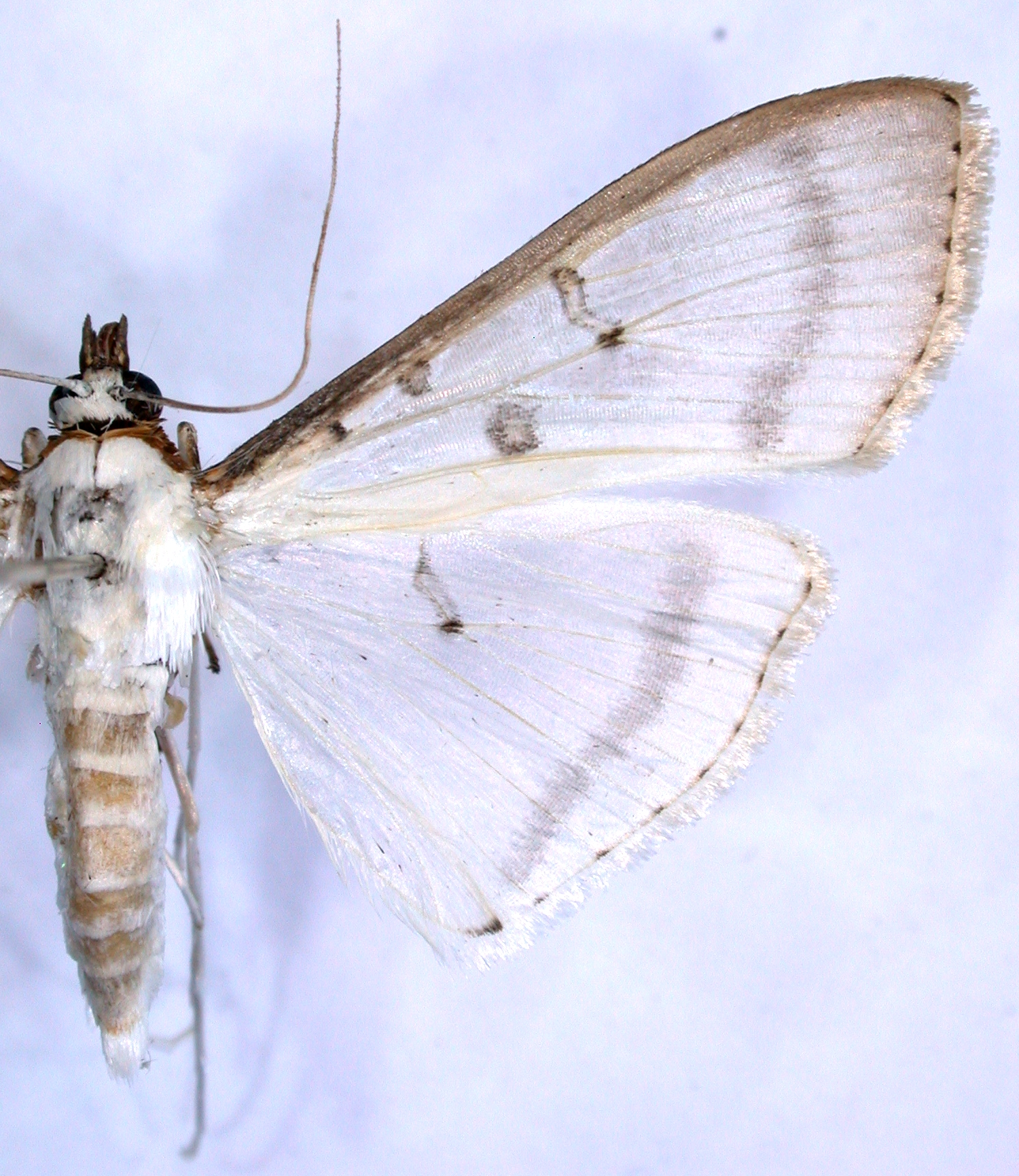
A shining silvery sp. with narrow sinuose marks ending in dark spots at the outer end of the disocellular cells of both wings. On the FW there are two small grey antemedian patches and a small circular spot towards the base of the subcosta. The subcostal and humeral areas of the thorax are brown. There is a narrow dark marginal line on both wings and a broad, difuse grey subtermenal line which Kirti & Rose 1992: describe as ‘slightly excurved in the middle’. There is a circular mark medially on the FW nr. the distal margin. In the male the body segments are striped pale fawn grey and white and there are long black and silver anal scent scales. Kirti & Rose, 1992, figs. 1, 2, 3 & 4.
The morpho-species Cydalima sp. 6 and sp. 7 show the extent of variability nr, C. warrenalis. It is probable that this may be a complex of similar spp. and many similar Palpita unidentified morphotypes are in the BOLD DNA data set. There appears to be considerable variation in the course taken by the grey subtermenal lines, the distinctness of the antemedian and post basal sub-termenal marks and the black neural spots may be less distinct in some specimens.
Munroe (1970) compared the characters of this sp. with those of P. curvilinea, P. varii, from Ceram, (Manusela) and P. janse, from New Guinea, Geelvink Bay (Mioswar Is.). He described these from holotypes drawn from the TS of P. pratti; characters differentiating these three spp. were given.
C. nigropunctalis is very similar and closely related but appears to have a much smaller solid mark medially on the FW nr. the distal margin. Included in the Kirti & Rose (1992: 63-65) key to the spp. of Palpita found in India [P. warrenalis, P. nigropunctalis, P. palpifulvata, P. annulata, P. pajnii, P. kiminensis, P. unionalis & P. hexcornutialis]. See Wang & Speidel (2000: 131).
References
- Bremer, O. (1864) Lepid. Ost-Sib., insbesondere der Amur-Landes, gesammelt von den Herren G. Radde, R. Maack und P. Wulffius. Mém. Acad. Sci. St. Pétersb. (7) 8 (1): 1-104, 8pls. St. Petersberg.
- Swinhoe, C. (1894c) VI A list of the Lepidoptera from the Khasia Hills. Trans. ent. Soc. Lond. 1894: 145-225.
- Wang, HsiauYue. & Speidel, W (2000) Guide Book to Insects in Taiwan (19). Pyraloidea (Pyralidae, Crambidae). Shu Shin Books, Taipei, Taiwan: pp 295.
- Ratnasingham, S. & Hebert, P.D.N.(2007) Barcoding - BOLD: The Barcode of Life Data System (www.barcodinglife.org), Molecular Ecology Notes (Journal compilation © 2007 Blackwell Publishing Ltd.: 10 pp.
- Kirti, J.S. & Rose, H.S. (1992b) Studies on Indian species of the genus Palpita Hubner (Lepidoptera: Pyralidae: Pyraustinae): J. Ent. Res. 16 (1): 62-77.
- Munroe, E. G. (1977a) Two new species of Palpita Hübner described by Janse, with descriptions of new species (Lepidoptera: Pyralidae: Pyraustinae). Can. Ent. (Ottawa), 109 (10): 67-76. doi:10.4039/Ent10967-1.